Manual Penuh (Web View)
Setiap page ada imej (scan PDF) + teks. Anda boleh scroll, cari, dan buka PDF asal.
Nota: Ini versi web untuk bacaan cepat. Untuk rujukan “layout asal”, guna butang Open PDF.
Page 1
BM
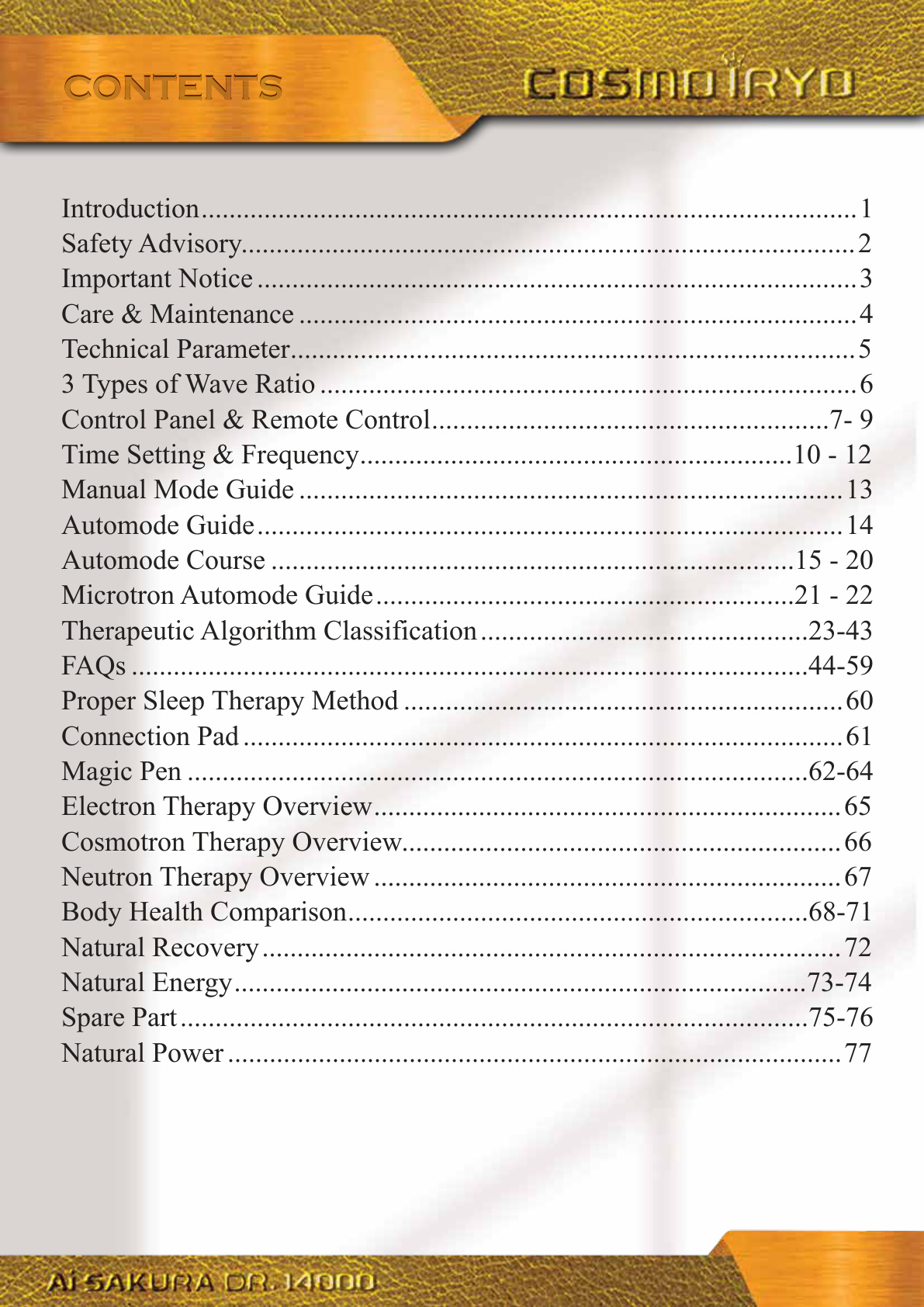
Introduction..............................................................................................1
Safety Advisory........................................................................................2
Important Notice ......................................................................................3
Care & Maintenance ................................................................................4
Technical Parameter.................................................................................5
3 Types of Wave Ratio .............................................................................6
Control Panel & Remote Control.........................................................7- 9
Time Setting & Frequency..............................................................10 - 12
Manual Mode Guide ..............................................................................13
Automode Guide....................................................................................14
Automode Course ...........................................................................15 - 20
Microtron Automode Guide............................................................21 - 22
Therapeutic Algorithm Classification...............................................23-43
SOALAN LAZIM .................................................................................................44-59
Proper Sleep Therapy Method ...............................................................60
Connection Pad ......................................................................................61
Magic Pen .........................................................................................62-64
Electron Therapy Overview...................................................................65
Cosmotron Therapy Overview...............................................................66
Neutron Therapy Overview ...................................................................67
Body Health Comparison..................................................................68-71
Natural Recovery...................................................................................72
Natural Energy..................................................................................73-74
Spare Part..........................................................................................75-76
Natural Power ........................................................................................77
CONTENTSCONTENTS
Image placeholder filename: img-01.jpg
• Recommended ratio: portrait 3:4 (or keep original page image)
Page 2
BM

To ensure patient safety and prevent potential interference with medical devices, do not use this
product in combination with the following:
This restriction may apply temporarily during specific clinical states. Documented physician approval
is required for concurrent use.
PRECAUTIONS: Always follow the instructions, warnings, and safety precautions in the user manual.
 Terminally ill or hospice patients must consult their physician before use.Implantable Electronic Devices (absolute contraindication): Pacemakers, ICDs, neurostimulators,
cochlear implants, and implantable pumps.
Risk: Proximity to this device may cause life-critical implant malfunction.
Life-Sustaining Medical Equipment: ECMO, ventilators, dialysis machines, intra-aortic balloon
pumps.
Risk: Signal distortion may mimic physiological events or obscure critical data.
Wearable Medical Monitoring Devices: Holter monitors, ambulatory ECGs, glucose monitors,
pulse oximeters.
Risk: Interference might make vital signs appear normal when they're not or show false alarms
when no problem exists.A Message of Appreciation
Important Conventional Medical Treatment DisclaimerMandatory Safety Protocols
All content contained in this publication shall not be construed as a substitute for professional medical
consultation or treatment. Accordingly, no information herein shall be interpreted as offering specific
prescriptions or pharmaceutical recommendations. The material is presented strictly for informational
and educational purposes and must not be employed to diagnose, ameliorate, treat, or manage any
medical condition. Any individual experiencing symptoms of an ailment or disorder must first seek
consultation from a registered medical practitioner or other suitably qualified healthcare professional
capable of rendering a diagnosis and recommending an appropriate course of treatment. Only after
such professional consultation may the user consider any adjunctive practices as a complementary
measure.
The articles contained herein reference educational frameworks and professional standards derived
from the Japanese context, in accordance with prevailing Japanese customs, culture, and statutory
regulations. Given these jurisdictional distinctions, the user must exercise their own discretion and
critical assessment when applying any learned material, whilst recognising that advice and treatment
from a qualified healthcare professional must always take precedence. Finally, the company explicitly
does not provide medical counsel, whether directly or indirectly. We neither advocate therapeutic
substitutions for prescribed medication, nor accept liability for any individual who elects to forgo
conventional medical treatment, fails to secure formal clinical consultation, or misuses this publication
or the device.
INTRODUCTIONINTRODUCTION
0101
We extend our profound gratitude and congratulations on your acquisition of the Japanese-engineered
nanoampere-range current stimulation, frequency-specific microcurrent, and electro-potential therapy
device for home use: the COSMO IRYO. With over two decades of operational experience and service
provision within Malaysia, Brunei, and Singapore, we commend your discerning selection in procuring
the COSMO IRYO AI SAKURA DR. 14000 model.
Image placeholder filename: img-02.jpg
• Recommended ratio: portrait 3:4 (or keep original page image)
Page 3
BM

Individuals with Acute Psychiatric Conditions: Persons experiencing significant psychological
distress, maladaptive behaviour, or conditions that could pose a risk to themselves or others.
Pregnancy: All pregnant women are strongly advised to seek medical advice; this is particularly
important for those with a history of poor health or pre-existing chronic conditions.
Undiagnosed Severe Symptoms: Patients suffering from extreme, unexplained pain or a chronic
illness without a formal diagnosis.
Non-Ambulatory Patients Without Adequate Support: Bedridden, paralysed, or dependent
individuals who cannot be safely positioned for therapy without professional assistance.
Acute Trauma or Haemorrhage: Individuals with active bleeding, serious accidental injuries, or those
in the peri-operative period of an amputation.
Serious Undiagnosed Infectious Illness: Patients presenting with severe symptoms possibly related
to a communicable disease outbreak, prior to a full diagnostic assessment.
Terminally Ill Patients Without Consent: This applies where therapy is not permitted by the treating
clinician or the patient's family.
Critically Ill Patients: This includes patients in Intensive Care (ICU/CCU), those who are intubated,
under sedation or anaesthesia, or dependent on critical medical devices (e.g., ECG monitors,
mechanical ventilators, or life-support systems).
Persistent Pyrexia (High Fever): Individuals with a sustained high fever that is not resolving require
medical investigation to determine and treat the underlying cause before commencing therapy.
Severely Disabled Individuals: Persons who, due to significant physical or cognitive impairment,
cannot participate in therapy without the direct and constant supervision of a fully able caregiver.
Recent Surgical Patients: Patients must wait until fully recovered from any major surgery or complex
procedure, typically for a minimum of one month, and must have confirmation from their surgeon
that the wound is healed with no risk of complication.Mandatory Pre-Therapy Screening: Patient Eligibility
and Contraindications
This list outlines critical safety contraindications. Consultation with a healthcare professional is
essential if any of these conditions apply.The following users or patients must seek advice and consent from an authorised doctor before using
this therapy device. Some individuals may also be temporarily prohibited from using the treatment.
SAFETY
ADVISORYSAFETY
ADVISORY
0202
Image placeholder filename: img-03.jpg
• Recommended ratio: portrait 3:4 (or keep original page image)
Page 4
BM

Operational and Safety Guidelines for Therapy
Device Users
Please ensure you drink an adequate amount of fresh, clear water such as plain or Hydrogen water both
before and after each therapy session.
To prevent damage to the machine, ensure its reliable operation, and maintain a safe environment,
please adhere to the following:
Keep Out of Reach of Children: Do not place the machine where it is easily accessible to children.
Avoid Contact During Use: Do not touch other people, electrical conductors, or the main unit's
housing while the device is operating. Do not pass objects to another person during a session.
Protect the Equipment from Liquids and Damage: Take care to prevent water from splashing onto
the host unit or the sitting/sleeping pad. Avoid exposing the machine to high-pressure water, open
flames, or excessive heat.
Suitable Environment: Do not use the device in damp, dusty, highly polluted, or vibrating
environments.
Sole Use of Device: Do not operate this therapy device simultaneously with other healthcare
equipment or heating blankets.
Action in Emergencies: In the event of a thunderstorm, earthquake, fire, flood, or power outage,
immediately switch the device off, disconnect the power cord from the mains supply, and postpone
use.
Do Not Insert Objects: Never insert fingers, metal objects, or any conductors into the machine’s
receptacle socket.Essential Safety InstructionsHydration Reminder
Operating Instructions for Specific Situations
IMPORTANT
NOTICEIMPORTANT
NOTICE
The following individuals must only use the device under the direct supervision of a family member or
professional caregiver and must not undergo therapy alone: elderly users; individuals with a mental
health condition or history of psychiatric illness; those with dementia or a cognitive impairment; infants
or young children; and individuals with a physical or cognitive disability.Please use the device only after your body has calmed down following the consumption of excessive
alcohol or intense physical exercise.Post-Exertion Use:
Required Supervision:
0303
Image placeholder filename: img-04.jpg
• Recommended ratio: portrait 3:4 (or keep original page image)
Page 5
BM

1.
2.
3.
4.
5.
6.
7.
8.
9.Storage Environment: Store and use the device in a cool, dry place. Avoid direct sunlight and
exposure to humid, dusty, or smoky conditions.
Cleaning: Always switch the device off before cleaning. To clean the main unit and the sitting/
sleeping pad, wipe them gently with a damp cloth or tissue. Do not use organic solvents, chemical
cleaners, or abrasive materials.
Long-Term Storage: If the device will not be used for an extended period, store it in a cool, dry
environment. To maintain the internal components, briefly switch the power on once a month.
Safe Handling: Handle the main unit with care and avoid turning it upside down. When connecting
or disconnecting the sitting/sleeping pad, Connection Cable, or Magic Pen, hold the connectors
(plugs and sockets) carefully to avoid damage.
Pad Inspection: Inspect the sitting/sleeping pad regularly. Replace it immediately if you notice any
physical damage, leakage, or if it produces a persistent "crackling" sound.
Electrical Safety: Always ensure your hands are dry before plugging or unplugging the power cord, or
before touching the power switch and control panel.
Cable Care: To prevent damage, avoid sharp bends, folds, or twists in the cables for the sitting/
sleeping pad, the Connection Cable, the Magic Pen, and the power cord.
Secure Connection: Before each use, ensure the sitting/sleeping pad cable is firmly and fully
inserted into the machine's output receptacle socket.
Discontinue Use Immediately If: Stop using the device and contact a technician if you observe any
of the following:
10.
11.
12.Correct Power Sequence: Always switch the device off at the main unit before unplugging any cables
or moving it. After your session, ensure the device is completely powered down.
No User Repairs: The device contains sensitive electronic components. Under no circumstances
should you attempt to disassemble or repair it yourself.
Malfunction Protocol: If the device malfunctions, is broken, or damaged, cease use immediately and
contact an authorised company technician for service.Smoke or unusual odours.
Moisture or foreign objects inside any connectors, cables, or the machine's receptacle socket.
Unexpected heat from the main unit, Sitting/Sleeping Pad, or Magic Pen.
Abnormal sounds or flashing lights from the device.
Visible damage to the main unit, Sitting/Sleeping Pad, or Magic Pen.Essential Maintenance Guide for Your Therapy Device
CARE &
MAINTENANCECARE &
MAINTENANCE
0404
Image placeholder filename: img-05.jpg
• Recommended ratio: portrait 3:4 (or keep original page image)
Page 6
BM
TECHNICAL
PARAMETERTECHNICAL
PARAMETER
0505
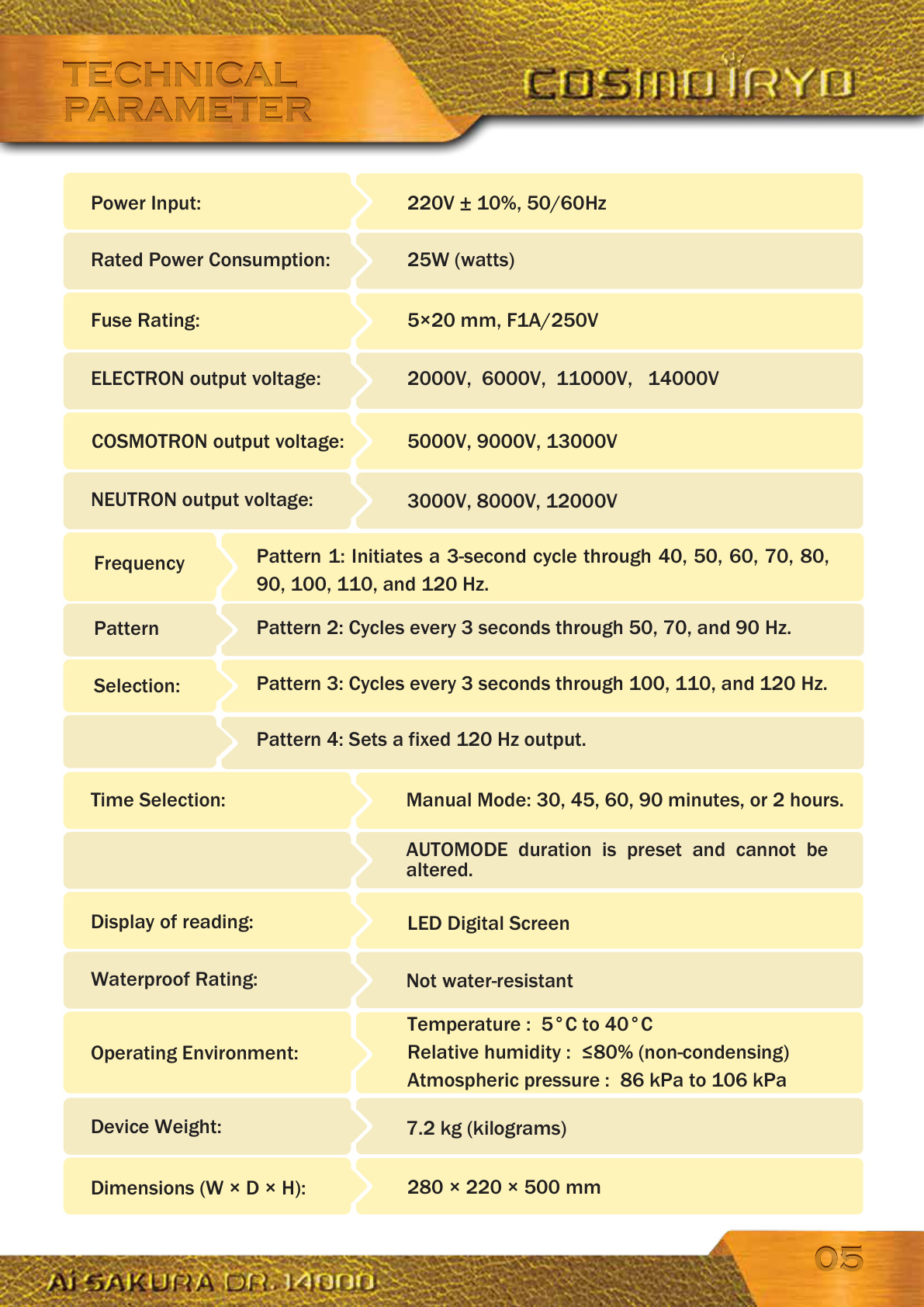
Power Input: 220V ± 10%, 50/60Hz
Rated Power Consumption: 25W (watts)
Fuse Rating: 5×20 mm, F1A/250V
ELECTRON output voltage: 2000V, 6000V, 11000V, 14000V
5000V, 9000V, 13000V
NEUTRON output voltage: 3000V, 8000V, 12000V
AUTOMODE duration is preset and cannot be
altered.
Display of reading: LED Digital ScreenTime Selection: Manual Mode: 30, 45, 60, 90 minutes, or 2 hours.
Not water-resistant Waterproof Rating:
7.2 kg (kilograms) Device Weight:Temperature : 5°C to 40°C
Relative humidity : ≤80% (non-condensing)
Atmospheric pressure : 86 kPa to 106 kPaOperating Environment:
280 × 220 × 500 mm Dimensions (W × D × H):COSMOTRON output voltage:
Pattern 1: Initiates a 3-second cycle through 40, 50, 60, 70, 80,
90, 100, 110, and 120 Hz.
Pattern 2: Cycles every 3 seconds through 50, 70, and 90 Hz.
Pattern 3: Cycles every 3 seconds through 100, 110, and 120 Hz.
Pattern 4: Sets a fixed 120 Hz output.Frequency
Pattern

Selection:
Image placeholder filename: img-06.jpg
• Recommended ratio: portrait 3:4 (or keep original page image)
Page 7
BM
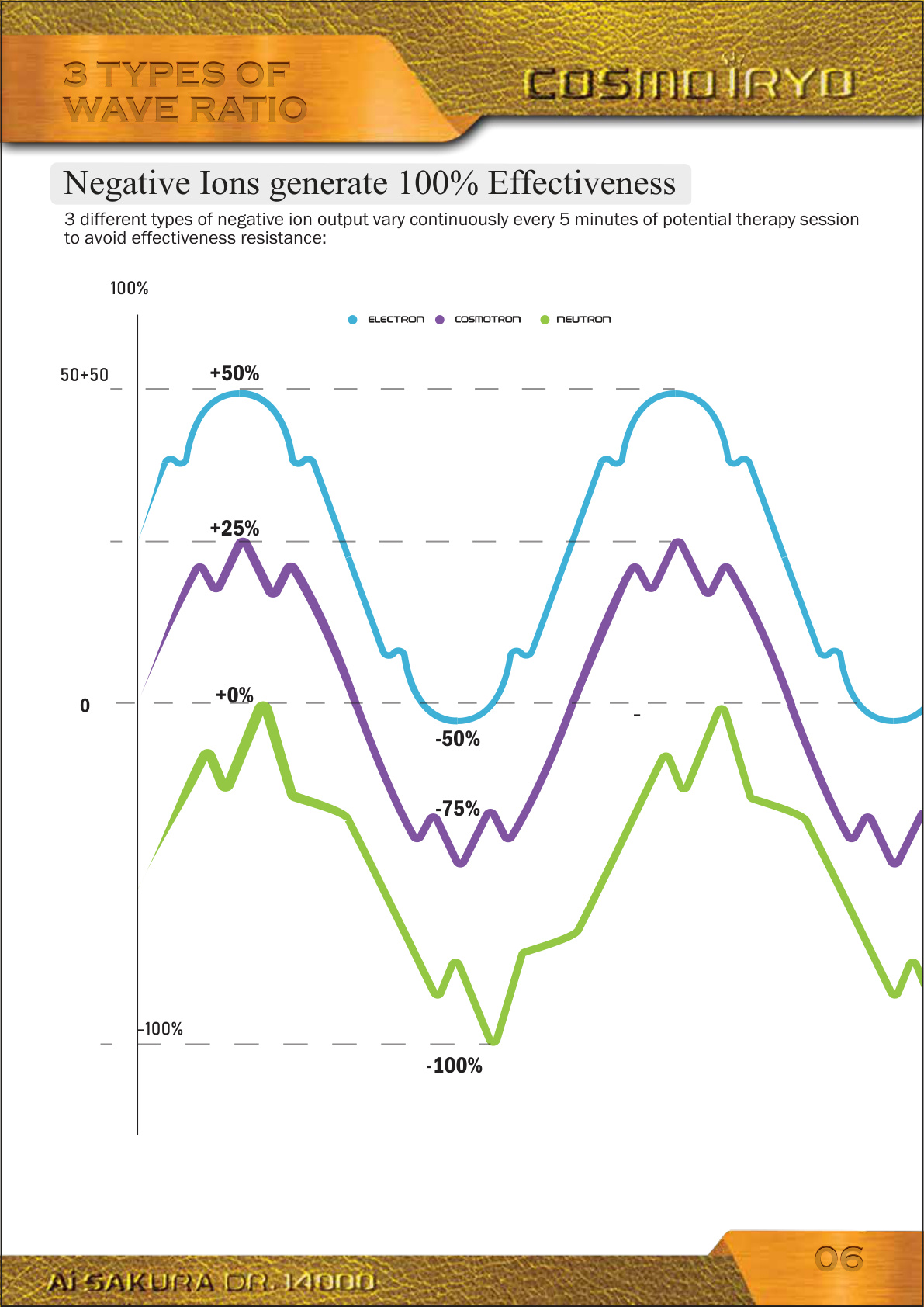
3 different types of negative ion output vary continuously every 5 minutes of potential therapy session
to avoid effectiveness resistance: Negative Ions generate 100% Effectiveness
+50%
+25%
+0%
-50%
-75%
-100%
3 TYPES OF
WAVE RATIO3 TYPES OF
WAVE RATIO
0606
Image placeholder filename: img-07.jpg
• Recommended ratio: portrait 3:4 (or keep original page image)
Page 8
BM
30/gid0006914000
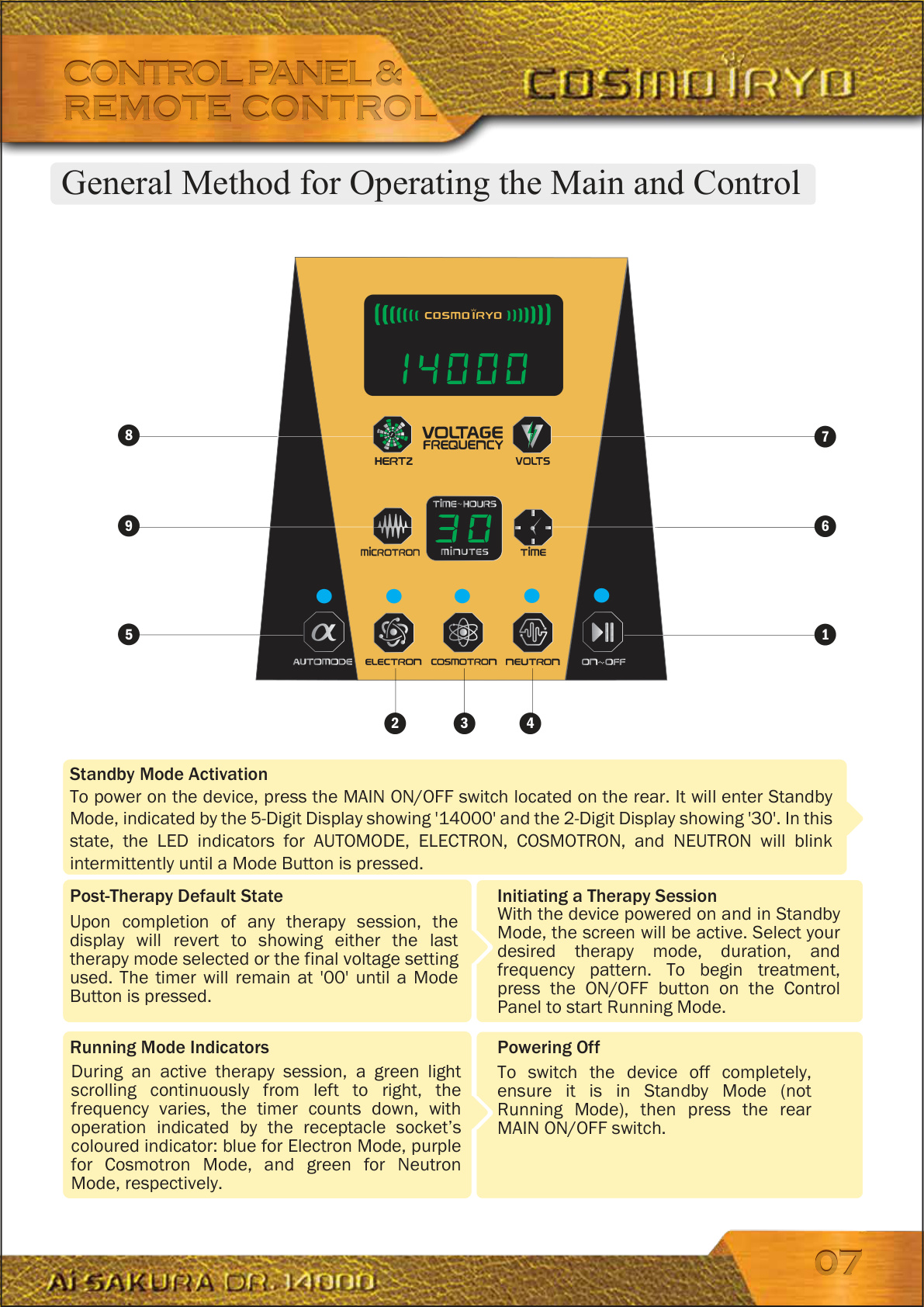
To power on the device, press the MAIN ON/OFF switch located on the rear. It will enter Standby
Mode, indicated by the 5-Digit Display showing '14000' and the 2-Digit Display showing '30'. In this
state, the LED indicators for AUTOMODE, ELECTRON, COSMOTRON, and NEUTRON will blink
intermittently until a Mode Button is pressed.General Method for Operating the Main and Control
167
4 3 28
5
Upon completion of any therapy session, the
display will revert to showing either the last
therapy mode selected or the final voltage setting
used. The timer will remain at '00' until a Mode
Button is pressed.
During an active therapy session, a green light
scrolling continuously from left to right, the
frequency varies, the timer counts down, with
operation indicated by the receptacle socket’s
coloured indicator: blue for Electron Mode, purple
for Cosmotron Mode, and green for Neutron
Mode, respectively.With the device powered on and in Standby
Mode, the screen will be active. Select your
desired therapy mode, duration, and
frequency pattern. To begin treatment,
press the ON/OFF button on the Control
Panel to start Running Mode.
To switch the device off completely,
ensure it is in Standby Mode (not
Running Mode), then press the rear
MAIN ON/OFF switch.Post-Therapy Default StateStandby Mode Activation
Initiating a Therapy Session
Running Mode Indicators Powering Off9
CONTROL PANEL &
REMOTE CONTROLCONTROL PANEL &
REMOTE CONTROL
0707
Image placeholder filename: img-08.jpg
• Recommended ratio: portrait 3:4 (or keep original page image)
Page 9
BM

The Button indicated to start or off (pause) the therapy session.
This button selects COSMOTRON therapy, which can be performed in Manual Mode with
a choice of 5000V, 9000V, or 13000V. The voltage and time for AUTOMODE are preset.
This button selects NEUTRON therapy,which can be performed in Manual Mode with a
choice of 3000V, 8000V, or 12000V. The voltage and time for AUTOMODE are preset.On/Off Button
Press the AUTOMODE button, and then press the ELECTRON and TIME buttons. The
display will show AU1, AU2, AU11, or AU12. Press the COSMOTRON and TIME buttons,
and the display will show AU3, AU4, AU13, or AU14. Alternatively, press the NEUTRON
and TIME buttons to display AU5, AU6, AU15, or AU16. The voltage strength will change
every 5 or 10 minutes within the AUTOMODE programme.AUTOMODE Button
This button is used to select the therapy duration, with available options of 30 minutes,
45 minutes, 60 minutes, 90 minutes, and 2 hours. The duration for AUTOMODE is preset
and cannot be altered.TIME Button
Press the VOLTAGE button to select the appropriate voltage after choosing your
desired Manual therapy mode type: either ELECTRON (2000V, 6000V, 11000V, or
14000V), COSMOTRON (5000V, 9000V, or 13000V), or NEUTRON (3000V, 8000V, or
12000V). The voltage for AUTOMODE cannot be set, as it is preset.VOLTAGE ButtonCOSMOTRON ButtonELECTRON Button
NEUTRON Button
/gid00069This button selects ELECTRON therapy, which can be performed in Manual Mode with
a choice of 2000V, 6000V, 11000V, or 14000V. The voltage and time for AUTOMODE
are preset.
A single press cycles every 3 seconds through 40–120 Hz, repeating. Subsequent
presses (2nd, 3rd, 4th) select shorter cycles: 50–90 Hz, 100–120 Hz, and a fixed 120
Hz output. Each pattern repeats from its start point.HERTZ Button
The MICROTRON features an AUTOMODE with both preset voltage and time settings.
To use the Magic Pen, press the MICROTRON button once to activate PEN 1, twice for
PEN 2, three times for PEN 3, or four times to initiate the 8-hour SLEEP program, with
each program repeating from its starting point.MICROTRON Button1
2
3
4
5
6
7
8
9
Main On/OffFuseAdapter
Input
0808
CONTROL PANEL &
REMOTE CONTROLCONTROL PANEL &
REMOTE CONTROL
Image placeholder filename: img-09.jpg
• Recommended ratio: portrait 3:4 (or keep original page image)
Page 10
BM

1411
1310
23
8
12671
45
6This button indicates the presence of electro-potential therapy. Press the button and
point the remote control correctly towards your body or the therapy pad; the light will
blink and a beeping sound will be emitted.
Pressing the AU1 button cycles through the AUTOMODE programme: once for AU1,
twice for AU2, three times for AU11, and four times for AU12. A subsequent press
returns the selection to AU1 mode.
Pressing the AU3 button cycles through the AUTOMODE programme: once for AU3,
twice for AU4, three times for AU13, and four times for AU14. A subsequent press
returns the selection to AU3 mode.TEST Button
AU1 Button (this setting is only applicable for the Japan language version)
(this setting is only applicable for the Japan language version)MUTE Button
AU3 ButtonPressing this button on the control panel or remote produces an audible beep. This
sound also occurs when each therapy session ends. You can deactivate this alert by
pressing the button, and reactivate it again if required.10
11
12
Pressing the AU5 button cycles through the AUTOMODE programme: once for AU5,
twice for AU6, three times for AU15, and four times for AU16. A subsequent press
returns the selection to AU5 mode.AU5 Button
1413
ELECTRO-POTENTIAL THERAPY DEVICEUser Manual
(this setting is only applicable for the Japan language version)
0909
CONTROL PANEL &
REMOTE CONTROLCONTROL PANEL &
REMOTE CONTROL
Image placeholder filename: img-10.jpg
• Recommended ratio: portrait 3:4 (or keep original page image)
Page 11
BM

Time Selection
Setting Your Session Duration
STEP 1:Turn the device on by switching the MAIN ON/OFF control to the 'On' position. The
unit will enter standby mode, and the display will show the default session time of
30 minutes.
STEP 2:To extend the session, press the TIME button once. The display will change from 30
minutes to 45 minutes.
On/Off Button
x 1
TIME Button
STEP 3:For a longer session, press the TIME button twice. This will adjust the time from 45
minutes to 60 minutes.
STEP 4:Press the TIME button three times to increase the duration from 60 minutes to 90
minutes.
x 2
TIME Button
x 3
TIME Button
TIME SETTING
& FREQUENCY TIME SETTING
& FREQUENCY
1010
Image placeholder filename: img-11.jpg
• Recommended ratio: portrait 3:4 (or keep original page image)
Page 12
BM

Setting Your Session Duration
STEP 7:When your therapy session is complete, the display will show 00 to indicate the
timer has finished.STEP 6:If you press the TIME button a fifth time, the selection cycle will restart at
30 minutes. You may continue pressing the button to cycle through all available
duration options until your preferred time is displayed.
x 5
TIME Button
Phase 1: Initial Setup and Standby Mode
Select either a manual therapy mode or AUTOMODE.
Once the MAIN ON/OFF switch is activated, the device enters Standby Mode. In this state, the 5-digit
display shows only the voltage. If the HERTZ button is not pressed, the reading will display 000 and
the frequency remains at a constant 70 Hz. This default setting is designed for first-time users.
To select a frequency pattern, press the HERTZ button. While in Standby Mode, the display shows a
static frequency reading, which is the first value in the chosen pattern. After selection in Running
Mode, the displayed frequency changes every 3 seconds.Frequency Pattern SelectionSTEP 5:For the maximum standard session length, press the TIME button four times to set
the timer to 120 minutes (2 hours).
x 4
TIME Button
1111
TIME SETTING
& FREQUENCY TIME SETTING
& FREQUENCY
Image placeholder filename: img-12.jpg
• Recommended ratio: portrait 3:4 (or keep original page image)
Page 13
BM

0 3 6 9 12 15 18 21 24 27 30 33 36 39 42 45 48 51 54 57 60102030405060708090100110120
Time (seconds)Frequency (Hz)
Phase 2: Pattern Options
For the first pattern, press the HERTZ button once. The frequency changes every 3 seconds in this
sequence: 40, 50, 60, 70, 80, 90, 100, 110, and 120 Hz. This cycle then repeats from 40 Hz.
For the second pattern, press the HERTZ button twice. The frequency changes every 3 seconds in
this sequence: 50, 70, and 90 Hz. This cycle then repeats from 50 Hz.
For the third pattern, press the HERTZ button three times. The frequency changes every 3 seconds
in this sequence: 100, 110, and 120 Hz. This cycle then repeats from 100 Hz.
For the fourth pattern, press the HERTZ button four times. The frequency remains fixed at 120 Hz
until the therapy session is complete.
Pressing the HERTZ button a fifth time returns the cycle to the first pattern. This sequence continues
with each subsequent press.Frequency Pattern Selection
Pattern 1 (40 -120 Hz cycle)Pattern 2 (50 - 70 - 90 Hz cycle)Pattern 3 (100 -110 -120 Hz cycle)Pattern 4 (Fixed 120 Hz cycle)
1212
TIME SETTING
& FREQUENCY TIME SETTING
& FREQUENCY
Image placeholder filename: img-13.jpg
• Recommended ratio: portrait 3:4 (or keep original page image)
Page 14
BM

Start Your Session: Once configured, press the ON/OFF button to begin. This active state is termed
Running Mode.
Make Adjustments During Therapy: You may change the voltage, frequency, or duration in real-time
by pressing the VOLTS, HERTZ, or TIME button directly during Running Mode. There is no need to
stop the session first.
Switching Modes: To change from another manual mode, press your desired mode button (e.g.,
from COSMOTRON to NEUTRON, press the NEUTRON button). If the device is in any AUTOMODE, you
must first press the AUTOMODE button once to exit the automatic programme and return to manual
control.
To configure and begin a therapy session in any Manual Mode, please follow this unified guide. The
initial steps are common across ELECTRON, COSMOTRON, and NEUTRON modes, with specific
instructions for voltage selection provided for each.
Once your mode is selected in standby, use the VOLTS button to choose your intensity.
After any session concludes, the display will show the last voltage setting you selected while in standby
mode.General Instructions for All Manual Modes
Mode-Specific V oltage SelectionPress the HERTZ button to choose a frequency variation pattern.
Press the TIME button to select your desired session duration.1.
2.
3.Initialise the Device: Switch the MAIN ON/OFF control to 'On'. The unit will enter standby mode.
Select Your Therapy Mode: Press the corresponding mode button: ELECTRON, COSMOTRON, or
NEUTRON. The display will show the default voltage for the selected mode.
Set Frequency and Time:
ELECTRON Mode
Default: 14,000V Default: 13,000V Default: 12,000VCOSMOTRON Mode NEUTRON Mode
Press the VOLTS button
once for 2,000V, twice for
6,000V, three times for
11,000V, or four times to
return to 14,000V. A fifth
press restarts the cycle.Press the VOLTS button
once for 5,000V, twice for
9,000V, or three times to
return to 13,000V. A fourth
press restarts the cycle.Press the VOLTS button
once for 3,000V, twice for
8,000V, or three times to
return to 12,000V. A fourth
press restarts the cycle.Comprehensive Manual Mode Operation Guide
MANUAL MODE
GUIDEMANUAL MODE
GUIDE
1313
Image placeholder filename: img-14.jpg
• Recommended ratio: portrait 3:4 (or keep original page image)
Page 15
BM

The AUTOMODE (AU) function comprises several advanced programmes with fixed, unchangeable
durations and automated therapy sequences. Each programme delivers a structured session during
which the voltage intensity and therapy mode rotate automatically at set intervals to provide a
comprehensive therapeutic experience.
Press the HERTZ button to choose a frequency variation pattern. This setting is optional; if no pattern is
selected, a default frequency will be used for the session.To configure and begin an AUTOMODE session, please follow these steps.
Each programme operates with a specific duration and automated cycle:
This automated structure ensures each session delivers a varied and intended therapeutic sequence.Once your programme is selected, press the ON/OFF button to begin the session. This active state is
termed Running Mode. The therapy will proceed automatically according to its predefined sequence.
These sessions run for a total duration of 60 minutes.
The voltage intensity changes automatically every 5 minutes throughout the session.
Additionally, the therapy mode rotates every 30 minutes, switching between Electron, Cosmotron,
and Neutron modes.STEP 1: Initialisation and Programme Selection
1.
2.Switch the MAIN ON/OFF control to 'On'. The unit will enter standby mode.
Press the AUTOMODE (AU) button repeatedly to cycle through and select your desired programme
number (e.g., AU1, AU2, AU3, AU4, AU5, AU6, AU11, AU12, AU13, AU14, AU15, or AU16).
STEP 2: Initiating Your Therapy Session
STEP 3: Programme Specifications and Automated Sequences
60-Minute Programmes (AU1, AU2, AU3, AU4, AU5, AU6):
These sessions run for a total duration of 2 hours (120 minutes).
The voltage intensity changes automatically every 10 minutes throughout the session.
The therapy mode rotates every hour, transitioning between the Electron, Cosmotron, and
Neutron modes.120-Minute Programmes (AU11, AU12, AU13, AU14, AU15, AU16):
STEP 4: Programme Specifications
AUTOMODE
GUIDEAUTOMODE
GUIDE
AUTOMODE Programme Operation
1414
Image placeholder filename: img-15.jpg
• Recommended ratio: portrait 3:4 (or keep original page image)
Page 16
BM

0 5 10 15 20 25 30 35 40 45 50 55 60Volts
Minutes
AUTOMODE 1 is a 60-minute programme. For the first 30 minutes, Electron Therapy alternates between
14,000 V and 11,000 V at five-minute intervals. It then proceeds to Cosmotron Therapy for the final 30
minutes, alternating between 13,000 V and 9,000 V, as shown in the graph.
AUTOMODE 2 is a 60-minute programme. In the initial 30 minutes, ELECTRON Therapy Mode starts at
6,000 V, alternating every 5 minutes with 11,000 V then 14,000V. The system then switches to
COSMOTRON Therapy for the next 30 minutes, starting at 5,000 V and alternating every 5 minutes with
9,000 V then 13,000 V, as indicated in the graph.
900011000
1000013000
1200014000
5000
4000
3000
2000
1000
70006000
8000
0 5 10 15 20 25 30 35 40 45 50 55 60Volts
900011000
1000013000
1200014000
5000
4000
3000
2000
1000
7000
6000
8000
Minutes
AUTOMODE
COURSEAUTOMODE
COURSE
1 (AU 1) Course Graph
2 (AU 2) Course Graph
1515
Image placeholder filename: img-16.jpg
• Recommended ratio: portrait 3:4 (or keep original page image)
Page 17
BM

3 (AU 3) Course Graph
4 (AU 4) Course Graph
0 5 10 15 20 25 30 35 40 45 50 55 60Volts
Minutes
0 5 10 15 20 25 30 35 40 45 50 55 60Volts
Minutes
9000
11000
1000013000
1200014000
5000
4000
3000
2000
1000
70006000
8000AUTOMODE 3 is a 60-minute programme. It begins with Cosmotron Therapy for 30 minutes,
switching between 9,000 V and 5,000 V every five minutes. The device then moves into Electron
Therapy for the next 30 minutes, alternating through 5,000 V, 9,000 V, and 13,000 V, as illustrated in
the graph.
AUTOMODE 4 is a 60-minute programme. During the initial 30 minutes, Cosmotron Therapy cycles
between 13,000 V and 5,000 V at five-minute intervals. The programme then changes over to Electron
Therapy for the final 30 minutes, alternating between 14,000 V and 6,000 V, as shown in the graph.
900011000
10000
13000
12000
14000
5000
4000
3000
2000
1000
7000
6000
8000
AUTOMODE
COURSEAUTOMODE
COURSE
1616
Image placeholder filename: img-17.jpg
• Recommended ratio: portrait 3:4 (or keep original page image)
Page 18
BM

0 5 10 15 20 25 30 35 40 45 50 55 60Volts
Minutes
0 5 10 15 20 25 30 35 40 45 50 55 60Volts
Minutes
9000
11000
10000
13000
12000
14000
5000
4000
3000
2000
1000
7000
60008000
9000
11000
10000
130001200014000
5000
4000
3000
2000
1000
700060008000AUTOMODE 5 is a 60-minute programme. The first half uses Neutron Therapy, alternating between
8,000 V and 3,000 V every five minutes. The second half applies Cosmotron Therapy, cycling between
5,000 V and 9,000 V, as indicated in the graph.
AUTOMODE 6 is a 60-minute programme. It starts with Neutron Therapy for 30 minutes, rotating through
12,000 V, 8,000 V, and 3,000 V at five-minute intervals. The programme then continues with Cosmotron
Therapy for the remaining 30 minutes, alternating through 14,000 V, 11,000 V, and 6,000 V, as shown
in the graph.
AUTOMODE
COURSEAUTOMODE
COURSE
1717
5 (AU 5) Course Graph
6 (AU 6) Course Graph
Image placeholder filename: img-18.jpg
• Recommended ratio: portrait 3:4 (or keep original page image)
Page 19
BM

1 1 (AU 1 1) Course Graph
1 2 (AU 1 2) Course Graph
0 10 20 30 40 50 60 70 80 90 100 110 120Volts
Minutes
0 10 20 30 40 50 60 70 80 90 100 110 120Volts
Minutes
900011000
1000013000
1200014000
5000
4000
3000
2000
1000
70006000
8000
900011000
1000013000
1200014000
5000
4000
3000
2000
1000
7000
6000
8000
AUTOMODE
COURSEAUTOMODE
COURSE
AUTOMODE 11 is a 120-minute programme. The session opens with 60 minutes of Electron
Therapy, alternating between 14,000 V and 11,000 V every ten minutes. It is followed by 60 minutes of
Cosmotron Therapy, alternating between 13,000 V and 9,000 V, as indicated in the graph.
AUTOMODE 12 is a 120-minute programme. In the first 60 minutes, Electron Therapy progresses in
ten-minute steps across 6,000 V, 11,000 V, and 14,000 V. The next 60 minutes switch to Cosmotron
Therapy, cycling across 5,000 V, 9,000 V, and 13,000 V, as shown in the graph.
1818
Image placeholder filename: img-19.jpg
• Recommended ratio: portrait 3:4 (or keep original page image)
Page 20
BM

1 3 (AU 1 3) Course Graph
1 4 (AU 1 4) Course Graph
0 10 20 30 40 50 60 70 80 90 100 110 120Volts
Minutes
0 10 20 30 40 50 60 70 80 90 100 110 120Volts
Minutes
9000
11000
1000013000
1200014000
5000
4000
3000
2000
1000
70006000
8000
900011000
10000
13000
12000
14000
5000
4000
3000
2000
1000
7000
6000
8000
AUTOMODE
COURSEAUTOMODE
COURSE
AUTOMODE 13 is a 120-minute programme. It commences with Cosmotron Therapy for 60 minutes,
alternating between 9,000 V and 5,000 V at ten-minute intervals. The following 60 minutes move to
Electron Therapy, rotating through 5,000 V, 9,000 V, and 13,000 V, as indicated in the graph.
AUTOMODE 14 is a 120-minute programme. For the first 60 minutes, Cosmotron Therapy alternates
between 13,000 V and 5,000 V every ten minutes. The programme then continues with Electron
Therapy for the next 60 minutes, alternating between 14,000 V and 6,000 V, as shown in the graph.
1919
Image placeholder filename: img-20.jpg
• Recommended ratio: portrait 3:4 (or keep original page image)
Page 21
BM

0 10 20 30 40 50 60 70 80 90 100 110 120Volts
Minutes
0 10 20 30 40 50 60 70 80 90 100 110 120Volts
Minutes
900011000
10000
130001200014000
5000
4000
3000
2000
1000
700060008000
9000
11000
10000
13000
12000
14000
5000
4000
3000
2000
1000
7000
60008000
AUTOMODE
COURSEAUTOMODE
COURSE
AUTOMODE 15 is a 120-minute programme. The initial 60 minutes deliver Neutron Therapy, alternating
between 8,000 V and 3,000 V at ten-minute intervals. The next 60 minutes apply Cosmotron Therapy,
cycling between 5,000 V and 9,000 V, as indicated in the graph.
AUTOMODE 16 is a 120-minute programme. It begins with Neutron Therapy for 60 minutes, stepping
through 12,000 V, 8,000 V, and 3,000 V in ten-minute cycles. The programme then switches to
Cosmotron Therapy for the next 60 minutes, rotating through 14,000 V, 11,000 V, and 6,000 V, as
shown in the graph.
2020
1 5 (AU 1 5) Course Graph
1 6 (AU 1 6) Course Graph
Image placeholder filename: img-21.jpg
• Recommended ratio: portrait 3:4 (or keep original page image)
Page 22
BM

2121
The MICROTRON function is a dedicated AUTOMODE (AU) programme comprising four distinct settings:
Pen 1, Pen 2, Pen 3, and SLEEP mode. Each setting has a preset therapy type, voltage, and duration
that cannot be changed manually. To configure and begin a MICROTRON session, follow the steps
below.
STEP 1: Mode Selection and Programme Specifications
1.
2.Switch the MAIN ON/OFF control to 'On'. The unit will enter standby mode.
Press the MICROTRON button repeatedly to select your programme:
STEP 2: Programme Setup
1.
2.
3.Method 1: Connect the male plug of the Magic Pen directly to the Receptacle Socket, then press the
MICROTRON button and select Pen 1, Pen 2, Pen 3, to begin therapy.
Method 2: Connect the Magic Pen connector directly to the metal cylindrical rod and place the rod
on the floor, then administer therapy using the pad while selecting Pen 1, Pen 2, Pen 3,
simultaneously.
For SLEEP mode, install the Sitting/Sleeping Pad into the Receptacle Socket before starting, select
SLEEP mode and begin therapy.
Microtron AUTOMODE Programme Operation Guide
MICROTRON
AUTOMODE GUIDEMICROTRON
PANDUAN MOD AUTO
Press once for Pen 1 (AU 7): → Delivers ELECTRON therapy at 2,000 Volts for 20 minutes.
MICROTRON
Button x 1
MICROTRON
Button x 2Press twice for Pen 2 (AU 8): → Delivers ELECTRON therapy at 6,000 Volts for 15 minutes.
MICROTRON
Button x 3Press three times for Pen 3 (AU 9): → Delivers NEUTRON therapy at 3,000 Volts for 10 minutes.
MICROTRON
Button x 4Press four times for SLEEP mode (AU 10): → Delivers ELECTRON therapy at 2,000 Volts for 8 hours.
Image placeholder filename: img-22.jpg
• Recommended ratio: portrait 3:4 (or keep original page image)
Page 23
BM

10 Course Graph
2222
For Pen 1, Pen 2, Pen 3, and SLEEP mode, regardless of the user’s health condition class,
the MICROTRON uses a Blood Group-Based Therapeutic Algorithm. The user’s blood group (O, A, B or
AB) is used to determine the correct Frequency Pattern Selection for the selected programme. Confirm
the user’s blood group, then select and apply the corresponding pattern:
0 480Volts
3000
2000
1000
Minutes
0 5 15 20 10Volts
5000
4000
3000
2000
1000
70006000
Minutes
The programmes are configured as follows: P en 1 → 2,000 volts for 20 minutes (Electron Therapy,
blue line); P en 2 → 6,000 volts for 15 minutes (Electron Therapy, blue line); and P en 3 → 3,000 volts
for 10 minutes (Neutron Therapy, green line).Pen 1Pen 2
Pen 3
SLEEP Mode runs for 480 minutes at 2,000 volts, and it functions only under Electron Mode.Press once: O → Pattern 1 (Start with 40 Hz)
Press twice: A → Pattern 2 (Start with 50 Hz)
Press three times: B → Pattern 3 (Start with 100 Hz)
Press four times: AB → Pattern 4 (Start with 120 Hz)STEP 4: Frequency SelectionPress the ON/OFF button to begin the session. The unit will enter Running Mode.
Although MICROTRON is an automatic mode, you do not need to press the AUTOMODE button to
activate it, and the LED on the AUTOMODE button will not be lit in either Standby Mode or
Running Mode.STEP 3: Starting Your Therapy Session
MICROTRON
AUTOMODE GUIDEMICROTRON
PANDUAN MOD AUTO
7 and , Course Graph 8 , 9 ,
Image placeholder filename: img-23.jpg
• Recommended ratio: portrait 3:4 (or keep original page image)
Page 24
BM

THERAPEUTIC ALGORITHM CLASSIFICATIONTHERAPEUTIC ALGORITHM CLASSIFICATION
2323
This Therapeutic Algorithm uses the user’s blood group (O, A, B, or AB) as the suitability input to
determine the correct Frequency Pattern Selection for the chosen programme mode. It is particularly
suitable for new users, the very elderly, those with low pain tolerance, bedridden individuals, and those
who experience strong reactions. To apply it, first identify the user’s health condition class, as shown
below:Section 1: Blood Group-Based Therapeutic Algorithm
Therapeutic Algorithm Selection Framework (Blood
Group-Based & Class-Based)
The user’s health condition class, from Class 1 to Class 16
Class 1 Cardiovascular Disorders
 Class 9Disorders Of The Lymphatic
System & Lymphoid Organs -
Lymph Nodes, Spleen, Thymus
Class 2 Respiratory Disorders
 Class 10 Dermatological Disorders
Class 3 Neurological Disorders
 Class 11 Central Sensory Processing
Class 4 Gastrointestinal Disorders
 Class 12 Cancers & Tumours
Class 5 Genitourinary Disorders
 Class 13Infectious And Parasitic
Diseases
Class 6Endocrine, Metabolic, and
Nutritional Disorders
Class 14Mental and Behavioural
Disorders
Class 7
 Class 13
Class 8 Blood & Immune System
 Class 16Musculoskeletal and Connective
Tissue DisordersDisorders Of Exogenous
Aetiology And Senescence
Systemic Disorders Of
Uncertain Or Complex Origin
User’s Health Condition Class vs Blood Group Programme
Image placeholder filename: img-24.jpg
• Recommended ratio: portrait 3:4 (or keep original page image)
Page 25
BM

THERAPEUTIC ALGORITHM CLASSIFICATIONTHERAPEUTIC ALGORITHM CLASSIFICATION
This algorithm generates a structured therapy schedule based solely on the user’s health condition
class, from Class 1 to Class 16, and does not use blood group information. To apply it, identify the
correct class, then follow the assigned schedule by selecting the designated programme mode and the
specified Frequency Pattern, including the recommended timing and frequency of use, whether daily,
weekly, or monthly.
Across Classes 1–16, the Blood Group-Based Therapeutic Algorithm (Section 1) delivers up to a 200%
increase in efficacy and overall treatment outcomes, while the Class-Based Therapeutic Algorithm
(Section 2) delivers a treatment plan with up to a 300% increase in efficacy and overall treatment
outcomes, compared with random, non-standardised use.
The Class-Based Therapeutic Algorithm is designed for users who are already familiar with the therapy,
having used it for an extended period of time. Comprehensive guidance and further details are
available on the subsequent pages.Section 2: Class-Based Therapeutic Algorithm Implementation Schedule
2424
Next, confirm the user’s blood group (O, A, B, or AB). Then, select and apply the corresponding
Frequency Pattern Selection:
Frequency Pattern Based on Blood-Group (O,A,B,AB)MICROTRON
4
8
12
163
7
11
152
6
10
141
5
9
132
6
12
161
3
8
145
9
11
154
7
10
13Mode Selection
The user’s health condition class, from Class 1 to Class 16
Pattern 1
(Start with 40 Hz)Pattern 2
(Start with 50 Hz)Pattern 3
(Start with 100 Hz)Pattern 4Blood O Blood A Blood B Blood AB
(Start with 120 Hz)User’s Health Condition Class vs Blood Group Programme
User’s Health Condition Class and Class-Based Programme
Image placeholder filename: img-25.jpg
• Recommended ratio: portrait 3:4 (or keep original page image)
Page 26
BM

THERAPEUTIC ALGORITHM CLASSIFICATIONTHERAPEUTIC ALGORITHM CLASSIFICATION
12
6
16
158
2
1
314
11
7
109
13
5
43
15
4
101
16
5
78
12
11
142
6
13
9Daily ( Alternative)
6am– 11pm (30 minutes or 1 hour)Weekly ( Alternative)
Administer twice per week
Pattern 1Medication
Schedule Timing
Mode
Selection
(Start with 40 Hz)
Pattern 2
(Start with 50 Hz)
Pattern 3
(Start with 100 Hz)
Pattern 4
(Start with 120 Hz)Frequency Selection
The user’s health condition class, from Class 1 to Class 16
2525
Pattern 1Medication
Schedule Timing
Mode
Selection
(Start with 40 Hz)Daily (Mandatory)
7 16 2 6 1 5 10 15 3 4 13 11
10 6 8 12 3 4 7 6 1 9 9 14
11 15 1 16 2 13 14 12 8 5 5 7
14 12 3 15 8 9 11 16 2 13 4 106am–6pmDaily (Essential)
6am–11pmWeekly (Booster)
Administer twice per week
Pattern 2
(Start with 50 Hz)
Pattern 3
(Start with 100 Hz)
Pattern 4
(Start with 120 Hz)Frequency SelectionThe user’s health condition class, from Class 1 to Class 16To use the programme, first determine the appropriate disease class (1–16) based on the user’s current
health condition. Second, select the relevant programme mode and confirm the recommended medica-
tion schedule timing for that mode. Third, choose the correct frequency pattern and commence therapy
at the specified starting frequency.User’s Health Condition Class and Class-Based Programme
Image placeholder filename: img-26.jpg
• Recommended ratio: portrait 3:4 (or keep original page image)
Page 27
BM

<1> Coronary Artery Disease: Angina, SA, UA,
Myocardial Infarction, Silent Ischemia, VA.
<2> Heart Failure: Systolic Heart Failure, Diastolic
Heart Failure, AHF, CHF, RSHF, LSHF, CHF,
HOHF.
<3> Arrhythmias (Aritmia): Atrial Fibrillation, AFL,
Supraventricular Tachycardia, VT, VF, Heart
Block, SSS, LQTS, WPW, PVCs, PACs.
<4> Valvular Heart Disease : Aortic Stenosis, AR,
MS,Mitral Regurgitation, TR, TS, PS, PR, MVP, IE,
RHD.
<5> Cardiomyopathies: DCM, HCM, RCM, ARVC,
TTC, PPCM.
<6> Pericardial Diseases : PEff, Tamponade, CP.<7> Congenital Heart Diseases: ASD, VSD, PDA,
TOF, TGA, CoA, HLHS, EA, TA, TAPVC.
<8> Vascular Diseases: Aortic Aneurysm, AD, PAD,
CAD, RAS, Mesenteric Ischemia, RP, TAO, VTE,
Deep Vein Thrombosis, PE, CVI, Varicose Veins,
LE, SVCS, IVCS.
<9> Hypertensive Disorders
<10> Inflammatory Heart Diseases : Myocarditis,
Endocarditis, Pericarditis, RF, KD.
<11> Cardiac Tumours
<12> Genetic Cardiovascular Disorders: Familial
Hypercholesterolaemia, HCM, LQTS, BrS, MFS,
vEDS, HHT.(Class 1) CARDIOVASCULAR DISORDERS
Cardiovascular Disorders, this Therapeutic Algorithm delivers a treatment plan with up to a 300%
increase in efficacy and overall treatment outcomes, compared with random, non-standardised use:Class 1 Algorithm Implementation Schedule
Category
Daily
(Mandatory)Programme/
TherapyFrequency Pattern
SelectionInstructions & Notes
Programme AU 3Pattern 1
(Start at 40 Hz)Use once during the daytime
(6 am – 6 pm).
Daily
(Essential)Programme AU 13Pattern 2
(Start at 50 Hz)Use once during waking hours
(6 am – 11 pm), if practicable.
Daily
(Alternative)Electron TherapyPattern 3
(Start at 100 Hz)Serves as an alternative to AU 13. It
may replace or be used concurrently.
For first-time users, commence at
6000V for 30 minutes.
Weekly
(Booster)Programme AU 5Pattern 3
(Start at 100 Hz)Administer twice per week.
Weekly
(Alternative)Neutron TherapyPattern 1
(Start at 40 Hz)Serves as an alternative to AU 5.
It may replace or be used
concurrently.
THERAPEUTIC ALGORITHM CLASSIFICATIONTHERAPEUTIC ALGORITHM CLASSIFICATION
2626
Image placeholder filename: img-27.jpg
• Recommended ratio: portrait 3:4 (or keep original page image)
Page 28
BM

<1> Upper Respiratory Tract Disorders: Common
Cold, Sinusitis , Pharyngitis , Tonsillitis, Allergic
Rhinitis, NAR, NP, DNS, Sleep Apnoea (SA), OSA,
CSA, MSA.
<2> Lower Respiratory Tract Disorders: Bronchitis,
CB, Bronchiectasis, Bronchiolitis, Asthma,
Chronic Obstructive Pulmonary Disease (COPD),
PNA, AP, Aspiration PNA, VAP, LA, Tuberculosis ,
NTM, Lung Infection, Pneumonia.
<3> Interstitial Lung Diseases: IPF, HP, CWP, DILD,
RILD, CTD-ILD, LAM, PLCH, PAP.
<4> Pleural Diseases: PEff, PTX, HTX, CTX, MPM.
<5> Pulmonary Vascular Diseases: PE, PH, PAVM,
PCH, PVOD.<6> Respiratory Failure: ARF, CRF, ARDS, CRI.
<7> Lung Cancer: NSCLC, SCLC,
<8> Chest Wall & Diaphragm Disorders: KS, PEx, PC,
FC, DP, DH, OHS.
<9> Occupational Lung Diseases: CWP, Byssinosis,
OA, Hypersensitivity Pneumonitis, Berylliosis,
HMLD, PWL.

<10> Genetic Respiratory Disorders: Cystic Fibrosis,
PCD, AATD, HHT, PAM, SPD.
<11> Respiratory Infections: CAP, HAP, VAP, HCAP,
TB, NTM.
<12> Other Respiratory Disorders: ATL, PE TBM,
Broncholithiasis, FBA.(Class 2) RESPIRATORY DISORDERS
Respiratory Disorders, this Therapeutic Algorithm delivers a treatment plan with up to a 300% increase
in efficacy and overall treatment outcomes, compared with random, non-standardised use:Class 2 Algorithm Implementation Schedule
THERAPEUTIC ALGORITHM CLASSIFICATIONTHERAPEUTIC ALGORITHM CLASSIFICATION
Category
Daily
(Mandatory)Programme/
TherapyFrequency Pattern
SelectionInstructions & Notes
Programme AU 3Pattern 3
(Start at 100 Hz)Use once during the daytime
(6 am – 6 pm).
Daily
(Essential)Programme AU 2Pattern 4
(Start at 120 Hz)Use once during waking hours
(6 am – 11 pm), if practicable.
Daily
(Alternative)Electron TherapyPattern 2
(Start at 50 Hz)Serves as an alternative to AU 2. It
may replace or be used concurrently.
For first-time users, commence at
6000V for 30 minutes.
Weekly
(Booster)Programme AU 5Pattern 2
(Start at 40Hz)Administer twice per week.
Weekly
(Alternative)Neutron TherapyPattern 1
(Start at 40 Hz)Serves as an alternative to AU 5.
It may replace or be used
concurrently.
2727
Image placeholder filename: img-28.jpg
• Recommended ratio: portrait 3:4 (or keep original page image)
Page 29
BM
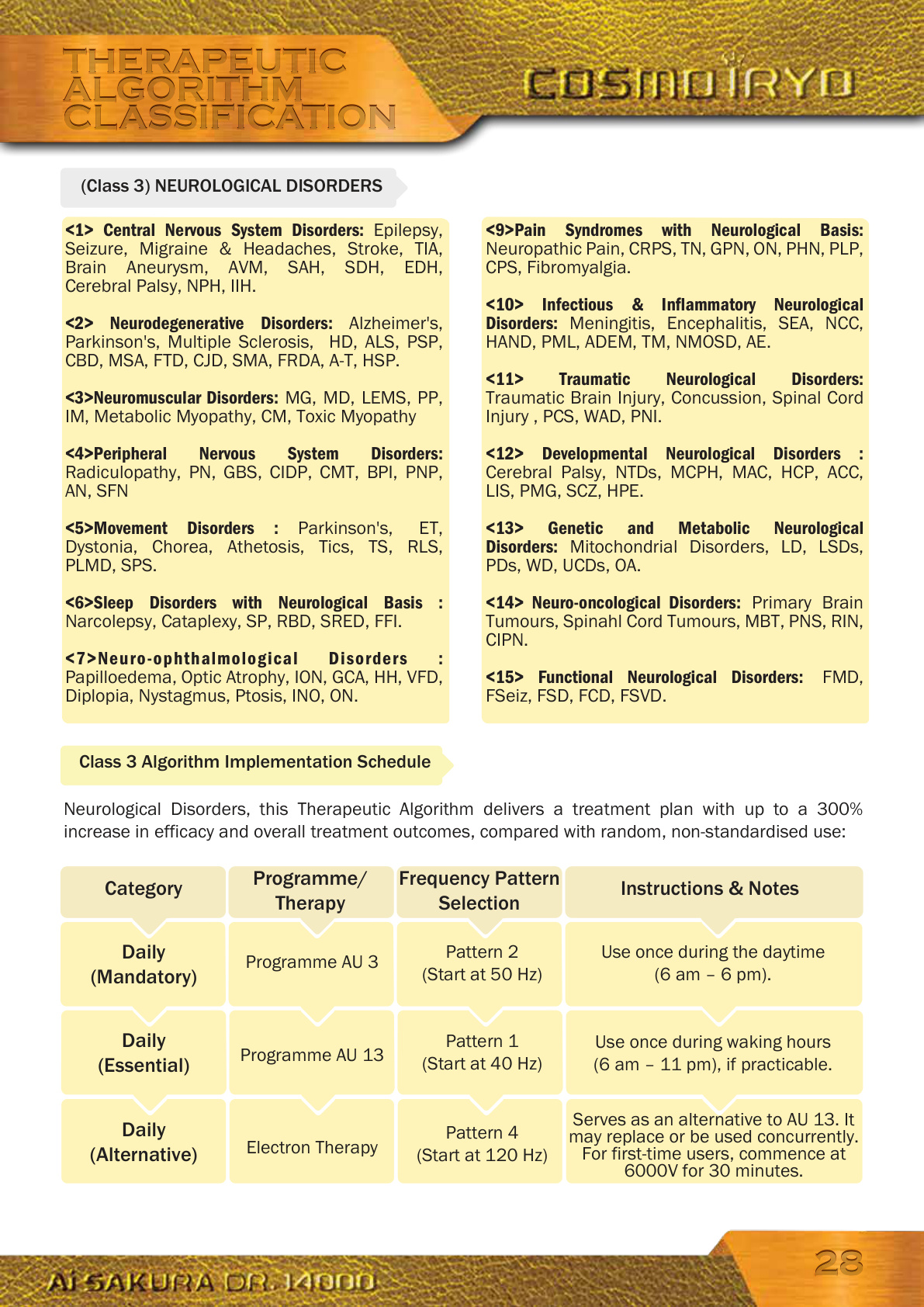
<9>Pain Syndromes with Neurological Basis:
Neuropathic Pain, CRPS, TN, GPN, ON, PHN, PLP,
CPS, Fibromyalgia.
<10> Infectious & Inflammatory Neurological
Disorders: Meningitis, Encephalitis, SEA, NCC,
HAND, PML, ADEM, TM, NMOSD, AE.
<11> Traumatic Neurological Disorders:
Traumatic Brain Injury, Concussion, Spinal Cord
Injury , PCS, WAD, PNI.
<12> Developmental Neurological Disorders :
Cerebral Palsy, NTDs, MCPH, MAC, HCP, ACC,
LIS, PMG, SCZ, HPE.
<13> Genetic and Metabolic Neurological
Disorders: Mitochondrial Disorders, LD, LSDs,
PDs, WD, UCDs, OA.
<14> Neuro-oncological Disorders: Primary Brain
Tumours, Spinahl Cord Tumours, MBT, PNS, RIN,
CIPN.
<15> Functional Neurological Disorders: FMD,
FSeiz, FSD, FCD, FSVD.<1> Central Nervous System Disorders: Epilepsy,
Seizure, Migraine & Headaches, Stroke, TIA,
Brain Aneurysm, AVM, SAH, SDH, EDH,
Cerebral Palsy, NPH, IIH.
<2> Neurodegenerative Disorders: Alzheimer's,
Parkinson's, Multiple Sclerosis, HD, ALS, PSP,
CBD, MSA, FTD, CJD, SMA, FRDA, A-T, HSP.
<3>Neuromuscular Disorders: MG, MD, LEMS, PP,
IM, Metabolic Myopathy, CM, Toxic Myopathy
<4>Peripheral Nervous System Disorders:
Radiculopathy, PN, GBS, CIDP, CMT, BPI, PNP,
AN, SFN
<5>Movement Disorders : Parkinson's, ET,
Dystonia, Chorea, Athetosis, Tics, TS, RLS,
PLMD, SPS.
<6>Sleep Disorders with Neurological Basis :
Narcolepsy, Cataplexy, SP, RBD, SRED, FFI.
<7>Neuro-ophthalmological Disorders :
Papilloedema, Optic Atrophy, ION, GCA, HH, VFD,
Diplopia, Nystagmus, Ptosis, INO, ON.
Neurological Disorders, this Therapeutic Algorithm delivers a treatment plan with up to a 300%
increase in efficacy and overall treatment outcomes, compared with random, non-standardised use:Class 3 Algorithm Implementation Schedule
THERAPEUTIC ALGORITHM CLASSIFICATIONTHERAPEUTIC ALGORITHM CLASSIFICATION
(Class 3) NEUROLOGICAL DISORDERS
Category
Daily
(Mandatory)Programme/
TherapyFrequency Pattern
SelectionInstructions & Notes
Programme AU 3Pattern 2
(Start at 50 Hz)Use once during the daytime
(6 am – 6 pm).
Daily
(Essential)Programme AU 13Pattern 1
(Start at 40 Hz)Use once during waking hours
(6 am – 11 pm), if practicable.
Daily
(Alternative)Electron TherapyPattern 4
(Start at 120 Hz)Serves as an alternative to AU 13. It
may replace or be used concurrently.
For first-time users, commence at
6000V for 30 minutes.
2828
Image placeholder filename: img-29.jpg
• Recommended ratio: portrait 3:4 (or keep original page image)
Page 30
BM

Class 3 Algorithm Implementation Schedule
<1> Oesophageal Disorders : Gastro-oesophageal
Reflux Disease (GERD), Oesophagitis, BE, DES,
NCE, EC, EV, MWT.
<2> Gastric Disorders : Gastritis, Peptic Ulcer
Disease , GC, GL, GP, Gastroparesis, MD, ZES,
HH, GV, GOO & DS.
<3> Small Intestinal Disorders : DU, CD, CeD, TS,
WD, SIBO, IL, MD, SBO, II, SIC, CT, & MAS.
<4> Large Intestinal Disorders : UC, IBS, DD, CP,
CRC, MC, IC, PMC, CV, HD,
Hemorrhoids, AF.
<5> Liver Disorders : Hepatitis, Cirrhosis, HCC,
Liver Cysts, Fatty Liver Disease, NAFLD, NASH,
ALD, WD, AATD, BCS, PHT, HE, HRS, PBC, PSC &
AIH.
<6> Gallbladder & Biliary Disorders : Gallstones, BD,
BS, CCA, GBC, BA, PSC. <7> Pancreatic Disorders : Pancreatitis, AP, CP, PC,
PD, HP, AIP, EPI, ICT.
<8> Peritoneal Disorders: Peritonitis, Ascites
<9> Functional Gastrointestinal Disorders : IBS, FD,
FAPS, FC, RS.
<10> Gastrointestinal Infections : GE, CDI, H.
pylori, Intestinal Parasites, TS, WD.
<11> Gastrointestinal Bleeding
<12> Nutritional and Metabolic Gastrointestinal
Disorders.

<13> Genetic Gastrointestinal Disorders: FAP, LS,
PJS, JPS, CS, CCS, HDGC, CF.
<14> Paediatric Gastrointestinal Disorders: GER, PS,
HD, NEC, MI, BA, ALGS.
<15> Other Gastrointestinal Disorders: Bezoars,
Foreign Body Ingestion, RE, GVHD, EGID.(Class 4) GASTROINTESTINAL DISORDERS
Gastrointestinal Disorders, this Therapeutic Algorithm delivers a treatment plan with up to a 300%
increase in efficacy and overall treatment outcomes, compared with random, non-standardised use:Class 4 Algorithm Implementation Schedule
THERAPEUTIC ALGORITHM CLASSIFICATIONTHERAPEUTIC ALGORITHM CLASSIFICATION
CategoryProgramme/
TherapyFrequency Pattern
SelectionInstructions & Notes
Weekly
(Alternative)Neutron TherapyPattern 1
(Start at 40 Hz)Serves as an alternative to AU 5.
It may replace or be used
concurrently.
Weekly
(Booster)Programme AU 5Pattern 4
(Start at 120 Hz)Administer twice per week.
CategoryProgramme/
TherapyFrequency Pattern
SelectionInstructions & Notes
Daily
(Essential)Programme AU 14Pattern 1
(Start at 40 Hz)Use once during waking hours
(6 am – 11 pm), if practicable.
2929
Image placeholder filename: img-30.jpg
• Recommended ratio: portrait 3:4 (or keep original page image)
Page 31
BM

Class 4 Algorithm Implementation Schedule
<4> Female Genital Disorders : ENDO, AM, Uterine
Fibroids , EH, EC, CC, OC, OCysts, Polycystic
Ovary Syndrome (PCOS), PID, Vaginitis , CT, BC,
VC, VaC, POP, Dysmenorrhoea , Premenstrual
Syndrome , Female Infertility , Menopause
Disorders , POI, TS.
<5> Sexually Transmitted Infections: CT, GC, TPA,
TV, HSV, HPV, HIV, HCD, LGV, & GI.
<6>Reproductive Disorders: Infertility , RPL, EP,
GTD, Placental Disorders, PTL, Postpartum
Complications, Menstrual Disorders, Sexual
Dysfunction.
<7> Genetic & Congenital Genitourinary Disorders:
Polycystic Kidney Disease, AS, CAH, DSD, MA,
Disorders of Sex Development.
<8> Other Genitourinary Disorders: RPF, FG, GUTB,
SCH, RC, CIC, GVHD.(Class 5) GENITOURINARY DISORDERS
<1> Kidney Disorders : Chronic Kidney Disease,
GN, NS, Polycystic Kidney Disease , Kidney
Stones RCC, RAS, HN, RTA, FS, AS, IgAN, LN, DN,
Hypertensive Nephropathy.
<2> Urinary Tract Disorders : Urinary Tract
Infections , Cystitis, Urethritis, IC, NB, Overactive
Bladder , UI, UR, BC, Bladder Stones , US, VUR,
UPJO, UVJO.
<3> Male Genital Disorders : Benign Prostatic
Hyperplasia , Prostatitis , PCa, TC, TT,
Epididymitis, Orchitis, Varicocele, HC,
Spermatocele, Phimosis, Paraphimosis,
Balanitis, PD, Priapism, ED, Premature
Ejaculation , Male Infertility , Hypospadias, CO,
KS.
THERAPEUTIC ALGORITHM CLASSIFICATIONTHERAPEUTIC ALGORITHM CLASSIFICATION
CategoryProgramme/
TherapyFrequency Pattern
SelectionInstructions & Notes
Daily
(Alternative)Cosmotron TherapyPattern 4
(Start at 120 Hz)Serves as an alternative to AU 14. It
may replace or be used concurrently.
For first-time users, commence at
5000V for 30 minutes.
Weekly
(Booster)Programme AU 15Pattern 4
(Start at 120 Hz)Administer twice per week.
Weekly
(Alternative)Neutron TherapyPattern 3
(Start at 100 Hz)Serves as an alternative to AU 15.
It may replace or be used
concurrently.Daily
(Mandatory)Programme AU 4Pattern 2
(Start at 50 Hz)Use once during the daytime
(6 am – 6 pm).
Daily
(Essential)Programme AU 14Pattern 1
(Start at 40 Hz)Use once during waking hours
(6 am – 11 pm), if practicable.
3030
Image placeholder filename: img-31.jpg
• Recommended ratio: portrait 3:4 (or keep original page image)
Page 32
BM

<1> Pituitary Disorders : Pituitary Adenoma, Prolac -
tinoma, Acromegaly, Gigantism, Dwarfism ,
Diabetes Insipidus, SIADH.
<2> Thyroid Disorders : Hypothyroidism,
Hyperthyroidism, Thyroid Nodules , Goitre .
<3> Parathyroid Disorders : Hyperparathyroidism,
Hypoparathyroidism, MEN.
<4> Adrenal Disorders : Adrenal Insufficiency,
Addison's Disease, Cushing's Syndrome,
Congenital Adrenal, Pheochromocytoma.
<5> Pancreatic Endocrine Disorders : Diabetes
Mellitus Type 1, Diabetes Mellitus Type 2,
Gestational Diabetes, Pancreatitis, Gestational
Diabetes, Insulinoma, MEN1, MODY.
<6> Metabolic Disorders : Metabolic Syndrome,
Insulin Resistance, Hypoglycaemia, Hyperglycaemia,
DKA, HHS, Lactic Acidosis, Uraemia, Gout,
Pseudogout. <7> Gonadal Disorders: Hypogonadism, Turner
Syndrome, PCOS, Testicular Failure.
<8> Nutritional Disorders: Malnutrition, Obesity,
Anorexia Nervosa, Bulimia Nervosa,
Dehydration, Nutrient Deficiency, Nutrient Toxicity.
<9> Inborn Errors of Metabolism (IEMs): PKU,
MSUD.
<10> Metabolic Bone Disorders: Osteoporosis,
Osteomalacia, Rickets, Bone Disease.
<11> Lipid Disorders: Hypercholesterolaemia,
Hypertriglyceridaemia, Tangier Disease.
<12> Carbohydrate Metabolism Disorders : Diabetes
Mellitus , Impaired Glucose Tolerance, Insulin
Resistance, Hypoglycaemia, Hyperglycaemia,
Galactosaemia.
<13> Amino Acid Metabolism Disorders:
Phenylketonuria, Urea Cycle Disorders,
Hyperlysinemia.(Class 6) ENDOCRINE, METABOLIC, & NUTRITIONAL DISORDERS
THERAPEUTIC ALGORITHM CLASSIFICATIONTHERAPEUTIC ALGORITHM CLASSIFICATION
Class 5 Algorithm Implementation Schedule
Category
Daily
(Mandatory)Programme/
TherapyFrequency Pattern
SelectionInstructions & Notes
Programme AU 4Pattern 1
(Start at 40 Hz)Use once during the daytime
(6 am – 6 pm).
Daily
(Essential)Programme AU 14Pattern 3
(Start at 100 Hz)Use once during waking hours
(6 am – 11 pm), if practicable.
Daily
(Alternative)Cosmotron TherapyPattern 3
(Start at 100 Hz)Serves as an alternative to AU 14. It
may replace or be used concurrently.
For first-time users, commence at
5000V for 30 minutes.
Weekly
(Booster)Programme AU 15Pattern 3
(Start at 100 Hz)Administer twice per week.
Weekly
(Alternative)Neutron TherapyPattern 3
(Start at 100 Hz)Serves as an alternative to AU 15.
It may replace or be used
concurrently.Genitourinary Disorders, this Therapeutic Algorithm delivers a treatment plan with up to a 300%
increase in efficacy and overall treatment outcomes, compared with random, non-standardised use:
3131
Image placeholder filename: img-32.jpg
• Recommended ratio: portrait 3:4 (or keep original page image)
Page 33
BM

Endocrine, Metabolic, & Nutritional Disorders, this Therapeutic Algorithm delivers a treatment plan with
up to a 300% increase in efficacy and overall treatment outcomes, compared with random,
non-standardised use:
THERAPEUTIC ALGORITHM CLASSIFICATIONTHERAPEUTIC ALGORITHM CLASSIFICATION
Class 6 Algorithm Implementation Schedule
Category
Daily
(Mandatory)Programme/
TherapyFrequency Pattern
SelectionInstructions & Notes
Programme AU 2Pattern 2
(Start at 50 Hz)Use once during the daytime
(6 am – 6 pm).
Daily
(Essential)Programme AU 12Pattern 2
(Start at 50 Hz)Use once during waking hours
(6 am – 11 pm), if practicable.
Daily
(Alternative)Electron TherapyPattern 2
(Start at 50 Hz)Serves as an alternative to AU 12. It
may replace or be used concurrently.
For first-time users, commence at
6000V for 30 minutes.
Weekly
(Booster)Programme AU 6Pattern 1
(Start at 40 Hz)Administer twice per week.
Weekly
(Alternative)Neutron TherapyPattern 2
(Start at 50 Hz)Serves as an alternative to AU 6.
It may replace or be used
concurrently.
(Class 7) MUSCULOSKELETAL & CONNECTIVE TISSUE DISORDERS
<6> Spinal Disorders : Degenerative Disc Disease,
Herniated Disc, Scoliosis, Spinal Fractures,
Lumbosacral Radiculopathy (Sciatica) .
<7> Joint Disorders : Joint Dislocation, Joint
Infections, Frozen Shoulder, TMD.
<8> Muscle Disorders : Muscle Cramps,
Dystrophies, Myopathies.
<9> Genetic Connective Tissue Disorders: MFS, EDS,
OI, STL, LDS, PXE, Cutis Laxa, HSD.
<10> Other Musculoskeletal Disorders: Complex
Regional Pain Syndrome, HC, WD, Reflex
Sympathetic Dystrophy, Chronic Fatigue
Syndrome.<1> Arthritis: Osteoarthritis (OA), Rheumatoid
Arthritis, Gout .
<2> Systemic Autoimmune Rheumatic Diseases:
Systemic Lupus Erythematosus, Systemic
Sclerosis.
<3> Vasculitis : Giant Cell Arteritis, TAK, PAN, GPA,
MPA.
<4> Soft Tissue Disorders : Fibromyalgia , Ligament
Sprains, Muscle Strains, Carpal Tunnel
Syndrome, Trigger Finger , MTSS, ITBS, PFPS.
<5> Bone Disorders : Osteoporosis, Osteomyelitis,
Fractures, AVN, HOA.
3232
Image placeholder filename: img-33.jpg
• Recommended ratio: portrait 3:4 (or keep original page image)
Page 34
BM

THERAPEUTIC ALGORITHM CLASSIFICATIONTHERAPEUTIC ALGORITHM CLASSIFICATION
Musculoskeletal & Connective Tissue Disorders, this Therapeutic Algorithm delivers a treatment plan
with up to a 300% increase in efficacy and overall treatment outcomes, compared with random,
non-standardised use:Class 7 Algorithm Implementation Schedule
Category
Daily
(Mandatory)Programme/
TherapyFrequency Pattern
SelectionInstructions & Notes
Programme AU 7Pattern 1
(Start at 40 Hz)Use once during the daytime
(6 am – 6 pm).
Daily
(Essential)Programme AU 11Pattern 2
(Start at 50 Hz)Use once during waking hours
(6 am – 11 pm), if practicable.
Daily
(Alternative)Cosmotron TherapyPattern 3
(Start at 100 Hz)Serves as an alternative to AU 11. It
may replace or be used concurrently.
For first-time users, commence at
5000V for 30 minutes.
Weekly
(Booster)Programme AU 16Pattern 3
(Start at 100 Hz)Administer twice per week.
Weekly
(Alternative)Neutron TherapyPattern 4
(Start at 120 Hz)Serves as an alternative to AU 16.
It may replace or be used
concurrently.
<1> Anaemias (Anemia) : Iron Deficiency Anaemia ,
Vitamin B12 Deficiency Anaemia , Folate
Deficiency Anaemia , Thalassaemia, Haemolytic
Anaemia, AIHA.
<2> Coagulation Disorders : Thrombocytopenia,
Haemophilia, Von Willebrand Disease ,
Thrombocytopenia , Hypercoagulable States,
DIC, ITP, TTP, APS.
<3> White Blood Cell Disorders : Neutropenia,
Leukocytosis, Leukopenia, Lymphocytosis,
Lymphopenia, Eosinophilia, Basophilia.(Class 8) BLOOD & IMMUNE SYSTEM DISEASES
<4> Bone Marrow Disorders : . Aplastic Anaemia,
Myelodysplastic Syndromes (MDS)
<5> Immunodeficiency Disorders : Secondary
Immunodeficiency, HIV/AIDS , SCID, CVID.
<6> Autoimmune Disorders : Systemic Lupus
Erythematosus (SLE), Rheumatoid Arthritis,
Autoimmune Thyroid Diseases, Type 1 Diabetes,
. Coeliac Disease , Psoriasis, Vitiligo, . Alopecia
Areata, Multiple Sclerosis.
(7) Allergic Disorders : Allergic Rhinitis, Asthma,
Food Allergies ,Eczema, Contact Dermatitis
3333
Image placeholder filename: img-34.jpg
• Recommended ratio: portrait 3:4 (or keep original page image)
Page 35
BM

THERAPEUTIC ALGORITHM CLASSIFICATIONTHERAPEUTIC ALGORITHM CLASSIFICATION
Blood & Immune System Diseases, this Therapeutic Algorithm delivers a treatment plan with up to a
300% increase in efficacy and overall treatment outcomes, compared with random, non-standardised
use:Class 8 Algorithm Implementation Schedule
Category
Daily
(Mandatory)Programme/
TherapyFrequency Pattern
SelectionInstructions & Notes
Programme AU 3Pattern 4
(Start at 120 Hz)Use once during the daytime
(6 am – 6 pm).
Daily
(Essential)Programme AU 13Pattern 3
(Start at 100 Hz)Use once during waking hours
(6 am – 11 pm), if practicable.
Daily
(Alternative)Electron TherapyPattern 1
(Start at 40 Hz)Serves as an alternative to AU 13. It
may replace or be used concurrently.
For first-time users, commence at
6000V for 30 minutes.
Weekly
(Booster)Programme AU 5Pattern 2
(Start at 50 Hz)Administer twice per week.
Weekly
(Alternative)Neutron TherapyPattern 1
(Start at 40 Hz)Serves as an alternative to AU 5.
It may replace or be used
concurrently.
<1> Lymphatic Vessel Disorders: Primary Lymphatic
Dysplasias: Primary lymphoedema, Secondary
Lymphatic Disorders: Secondary lymphoedema
(e.g., post-surgical, post-radiation).
<2> Lymph Node Disorders : Reactive & Inflammatory
Disorders: lymphadenopathy. Specific
Non-Infectious Disorders: Castleman disease. (Class 9) DISORDERS OF THE LYMPHATIC SYSTEM & LYMPHOID ORGANS - LYMPH NODES,
SPLEEN, THYMUS
<3> Splenic Disorders : Structural &
Functional Disorders: Splenomegaly, asplenia,
splenic infarction, splenic cysts.
<4> Thymic Disorders : Thymic Structural
Disorders: Thymoma, thymic hyperplasia.
<5> Lymphatic Circulation Disorders: Primary &
Secondary Disorders: Disorders of lymphatic
flow and drainage.
Disorders Of The Lymphatic System & Lymphoid Organs - Lymph Nodes, Spleen, Thymus, this
Therapeutic Algorithm delivers a treatment plan with up to a 300% increase in efficacy and overall
treatment outcomes, compared with random, non-standardised use:Class 9 Algorithm Implementation Schedule
3434
Image placeholder filename: img-35.jpg
• Recommended ratio: portrait 3:4 (or keep original page image)
Page 36
BM

THERAPEUTIC ALGORITHM CLASSIFICATIONTHERAPEUTIC ALGORITHM CLASSIFICATION
Class 9 Algorithm Implementation Schedule
Category
Daily
(Mandatory)Programme/
TherapyFrequency Pattern
SelectionInstructions & Notes
Programme AU 4Pattern 4
(Start at 120 Hz)Use once during the daytime
(6 am – 6 pm).
Daily
(Essential)Programme AU 14Pattern 2
(Start at 50 Hz)Use once during waking hours
(6 am – 11 pm), if practicable.
Daily
(Alternative)Cosmotron TherapyPattern 1
(Start at 40 Hz)Serves as an alternative to AU 14. It
may replace or be used concurrently.
For first-time users, commence at
5000V for 30 minutes.
Weekly
(Booster)Programme AU 15Pattern 2
(Start at 50 Hz)Administer twice per week.
Weekly
(Alternative)Neutron TherapyPattern 4
(Start at 120 Hz)Serves as an alternative to AU 15.
It may replace or be used
concurrently.
<1> Inflammatory Skin Diseases : Dermatitis,
Eczema, Psoriasis, Rosacea, Acne , Hives,
Cutaneous, LP, PR, HS, EM, SJS, TEN, BP, DH,
GA, PG, SS.
<2> Infectious Skin Diseases : Bacterial-Boils ,
Viral-Warts , Fungal-Ringworm ,
Parasitic-Scabies, STIs, STDs.
<3> Blistering Diseases : PV, BP, DH, EB, PCT, LAD,
CBDC.
<4> Papulosquamous Disorders: Psoriasis, LP, PR,
Parapsoriasis, PRP, RS.
<5> Disorders of Pigmentation: . Vitiligo, Melasma,
PIH, Albinism (Albino), WS, IP.
<6> Hair Disorders : AA, AGA, TE, TTM, Pili Torti,
LAS, FFA, LPP, FD, DCS, CCCA.
<7> Nail Disorders : Onychomycosis , Psoriatic Nail
Disease, Onycholysis, Paronychia, Ingrown
Toenail , Clubbing. (Class 10) DERMATOLOGICAL DISORDERS
<8> Sebaceous and Sweat Gland Disorders : Acne,
Miliaria, Hyperhidrosis , Bromhidrosis ,
Chromhidrosis.
<9> Vascular Skin Disorders: Angioma, Purpura,
Vasculitis.
<10> Benign Skin Growths : Seborrhoeic Keratosis,
Skin Tags , Lipoma, Keloid, Hypertrophic Scar,
Granuloma .
<11> Premalignant & Malignant Skin Conditions :
(e.g. Actinic Keratosis, Basal Cell Carcinoma,
Squamous Cell Carcinoma, Melanoma.)
<12> Genetic Skin Disorders : e.g. EB, DD, HHD, PC,
NF, TSC, XP & sim.
<13> Skin Manifestations of Systemic Diseases :
e.g. Liver Disease, Kidney Disease, Thyroid
Disorders & rel. cond.
<14> Other Dermatological Conditions: e.g. Pruritus,
Itching , Xerosis , Asteatotic Eczema, Stasis
Dermatitis.
3535
Image placeholder filename: img-36.jpg
• Recommended ratio: portrait 3:4 (or keep original page image)
Page 37
BM

THERAPEUTIC ALGORITHM CLASSIFICATIONTHERAPEUTIC ALGORITHM CLASSIFICATION
Dermatological Disorders, this Therapeutic Algorithm delivers a treatment plan with up to a 300%
increase in efficacy and overall treatment outcomes, compared with random, non-standardised use:Class 10 Algorithm Implementation Schedule
Category
Daily
(Mandatory)Programme/
TherapyFrequency Pattern
SelectionInstructions & Notes
Programme AU 1Pattern 2
(Start at 50 Hz)Use once during the daytime
(6 am – 6 pm).
Daily
(Essential)Programme AU 11Pattern 1
(Start at 40 Hz)Use once during waking hours
(6 am – 11 pm), if practicable.
Daily
(Alternative)Cosmotron TherapyPattern 4
(Start at 120 Hz)Serves as an alternative to AU 11. It
may replace or be used concurrently.
For first-time users, commence at
5000V for 30 minutes.
Weekly
(Booster)Programme AU 16Pattern 4
(Start at 120 Hz)Administer twice per week.
Weekly
(Alternative)Neutron TherapyPattern 4
(Start at 120 Hz)Serves as an alternative to AU 16.
It may replace or be used
concurrently.
<1> Refractive Errors: Nearsightedness ,
Farsightedness , Astigmatism, Presbyopia.
<2> Cataracts
<3> Glaucoma
<4> Retinal Disorders : e.g. Age-Related Macular
Degeneration, Diabetic Retinopathy & sim.
<5> Vitreous Disorders
<6> Optic Nerve Disorders : e.g. Optic Neuritis,
Papilloedema & sim.
<7> Corneal Disorders : e.g. Keratitis, Corneal
Ulcer, Keratoconus, Corneal Abrasion, Dry Eye
Syndrome & rel. cond.
<8> Conjunctival Disorders: e.g. Conjunctivitis,
Subconjunctival Haemorrhage & rel. cond. (11.A) EYE DISORDERS (Class 11) CENTRAL SENSORY PROCESSING SYSTEM
<9> Scleral Disorders
<10> Uveal Tract Disorders : e.g. Uveitis, Iritis.
<11> Eyelid Disorders: e.g. Blepharitis, Hordeolum,
Chalazion.
<12> Lacrimal System Disorders : e.g. Dry Eye
Syndrome, Epiphora .
<13> Orbital Disorders: Orbital Cellulitis, Thyroid
Eye Disease.
<14> Extraocular Muscle Disorders: Strabismus ,
Amblyopia, Ocular.
<16> Neuro-ophthalmic Disorders: e.g. Migraine
with Aura.
<17> Genetic Eye Disorders : e.g. Colour Blindness .
3636
Image placeholder filename: img-37.jpg
• Recommended ratio: portrait 3:4 (or keep original page image)
Page 38
BM

<18> Traumatic Eye Disorders: e.g. Corneal
Abrasion, Orbital Fracture. (11.A) EYE DISORDERS
<19> Other Eye Disorders: Floaters , Flashes,
Photophobia, Eye Strain.
<1> External Ear Disorders: Otitis Externa,
Swimmer's Ear, Ear Wax Impaction.
<2> Middle Ear Disorders: Otitis Media,
Cholesteatoma, Tympanic Membrane Perforation ,
Mastoiditis.
<3> Inner Ear Disorders: Hearing Loss, Presbycusis ,
Ototoxicity, BPPV Motion Sickness .
<4> Auditory Processing Disorders(11.B) EAR DISORDERS
<6> Balance Disorders: Vertigo, Dizziness,
Imbalance , Syncope , Motion Sickness , Visual
Vertigo.
<7> Genetic Ear Disorders: Congenital Hearing
Loss, Otosclerosis.
<8> Traumatic Ear Disorders: Acoustic Trauma,
Barotrauma, TMP, Foreign Body in the Ear.
<9> Other Ear Disorders: Ear Pain, Ear Itching,
Otorrhoea , Eustachian Tube Dysfunction,
Hyperacusis.
THERAPEUTIC ALGORITHM CLASSIFICATIONTHERAPEUTIC ALGORITHM CLASSIFICATION
Central Sensory Processing System, this Therapeutic Algorithm delivers a treatment plan with up to a
300% increase in efficacy and overall treatment outcomes, compared with random, non-standardised use:Class 11 Algorithm Implementation Schedule
Category
Daily
(Mandatory)Programme/
TherapyFrequency Pattern
SelectionInstructions & Notes
Programme AU 1Pattern 3
(Start at 100 Hz)Use once during the daytime
(6 am – 6 pm).
Daily
(Essential)Programme AU 11Pattern 4
(Start at 120 Hz)Use once during waking hours
(6 am – 11 pm), if practicable.
Daily
(Alternative)Cosmotron TherapyPattern 2
(Start at 50 Hz)Serves as an alternative to AU 11. It
may replace or be used concurrently.
For first-time users, commence at
5000V for 30 minutes.
Weekly
(Booster)Programme AU 16Pattern 1
(Start at 40 Hz)Administer twice per week.
Weekly
(Alternative)Neutron TherapyPattern 3
(Start at 100 Hz)Serves as an alternative to AU 16.
It may replace or be used
concurrently.
3737
Image placeholder filename: img-38.jpg
• Recommended ratio: portrait 3:4 (or keep original page image)
Page 39
BM

<1> Benign Neoplasms :
<a> Benign Epithelial & Soft Tissue Tumours:
Meningioma, Pilomatrixoma, Lipoma, Uterine
Leiomyoma, Hepatic Haemangioma.
<b> Benign Central Nervous System Tumours:
Pilocytic Astrocytoma, Schwannoma.
<2> Premalignant
<a> Epithelial Dysplasias & In Situ Neoplasia:
Cervical Intraepithelial Neoplasia (CIN), DCIS,
Colonic Adenoma.
<b> Preneoplastic Syndromes: MDS
<3> Malignant Neoplasms :
<a> Carcinomas (Malignant Epithelial Tumours):
Lung Cancer, Breast Cancer, Prostate Cancer,
Pancreatic Cancer, Liver Cancer (Hepatocellular
Carcinoma), Gastric (Stomach) Cancer, Renal
Cell (Kidney) Cancer, Ovarian Cancer,
Skin Cancers (Non-Melanoma; e.g., Basal Cell
Carcinoma, Squamous Cell Carcinoma), Penile
Cancer, Vaginal Cancer.
<b> Sarcomas (Malignant Connective Tissue
Tumours): Osteosarcoma, Ewing Sarcoma,
Leiomyosarcoma, Fibrosarcoma.
<c> Lymphomas (Malignant Lymphoid Tumours):
Hodgkin Lymphoma, Non-Hodgkin Lymphoma
(NHL), Burkitt Lymphoma, Cutaneous T-Cell
Lymphoma (CTCL), Primary Central Nervous
System Lymphoma (PCNSL). (CLASS 12) CANCERS & TUMOURS
<d> Leukaemias (Malignant Haematological
Tumours): Acute Lymphoblastic Leukaemia (ALL),
Acute Myeloid Leukaemia (AML), Chronic
Lymphocytic Leukaemia (CLL), Chronic Myeloid
Leukaemia (CML).
<e> Malignant Central Nervous System Tumours:
Glioblastoma, Astrocytoma (grades II-IV),
Medulloblastoma, Malignant Meningioma,
Spinal Cord Tumours.
<f> Other Specific Malignant Neoplasms: Germ Cell
Tumours (e.g., Testicular Seminoma),
Neuroendocrine Tumours (e.g., Pancreatic NET),
Carcinoid Tumours, Melanoma, Wilms Tumour
(Nephroblastoma), Paraganglioma (e.g.,
Phaeochromocytoma).
<4> Neoplasms of Intermediate, Borderline, or
Uncertain Malignant Potential :
<a> Borderline Tumours: Borderline Ovarian Tumour
(e.g., Serous Borderline Tumour), Phyllodes
Tumour of the breast.
<b> Tumours of Uncertain Behaviour:
Gastrointestinal Stromal Tumour (GIST)
(behaviour varies by specific mutations and
size).
THERAPEUTIC ALGORITHM CLASSIFICATIONTHERAPEUTIC ALGORITHM CLASSIFICATION
Cancers & Tumours, this Therapeutic Algorithm delivers a treatment plan with up to a 300% increase in
efficacy and overall treatment outcomes, compared with random, non-standardised use:Class 12 Algorithm Implementation Schedule
Category
Daily
(Mandatory)Programme/
TherapyFrequency Pattern
SelectionInstructions & Notes
Programme AU 2Pattern 4
(Start at 120 Hz)Use once during the daytime
(6 am – 6 pm).
Daily
(Essential)Programme AU 12Pattern 3
(Start at 100 Hz)Use once during waking hours
(6 am – 11 pm), if practicable.
Daily
(Alternative)Electron TherapyPattern 1
(Start at 40 Hz)Serves as an alternative to AU 12. It
may replace or be used concurrently.
For first-time users, commence at
6000V for 30 minutes.
3838
Image placeholder filename: img-39.jpg
• Recommended ratio: portrait 3:4 (or keep original page image)
Page 40
BM

THERAPEUTIC ALGORITHM CLASSIFICATIONTHERAPEUTIC ALGORITHM CLASSIFICATION
Class 12 Algorithm Implementation Schedule
CategoryProgramme/
TherapyFrequency Pattern
SelectionInstructions & Notes
Weekly
(Booster)Programme AU 6Pattern 2
(Start at 50 Hz)Administer twice per week.
Weekly
(Alternative)Neutron TherapyPattern 2
(Start at 50 Hz)Serves as an alternative to AU 6.
It may replace or be used
concurrently.
<1> Bacterial Infections : Tuberculosis , Tetanus ,
Bacterial Pneumonia.

<2> Viral Infections : Influenza, Hepatitis A, B, C,
D, and E, Herpes, HPV, CMV, Mumps , Hand, Foot
& Mouth Disease , Meningitis, Long Covid.(Class 13) INFECTIOUS AND PARASITIC DISEASES
<3> Fungal Infections : Thrush , Fungal Nail
Infection , Ringworm Tinea Versicolor , Jock Itch.
<4> Parasitic Infections : Helminthiasis , Scabies.
(5) Other Infectious Diseases : Mycoplasma
Infections , Sexually Transmitted Infections
(STIs) And Diseases (STDs) .
Infectious And Parasitic Diseases, this Therapeutic Algorithm delivers a treatment plan with up to a
300% increase in efficacy and overall treatment outcomes, compared with random, non-standardised use:Class 13 Algorithm Implementation Schedule
Category
Daily
(Mandatory)Programme/
TherapyFrequency Pattern
SelectionInstructions & Notes
Programme AU 4Pattern 3
(Start at 100 Hz)Use once during the daytime
(6 am – 6 pm).
Daily
(Essential)Programme AU 14Pattern 4
(Start at 120 Hz)Use once during waking hours
(6 am – 11 pm), if practicable.
Daily
(Alternative)Cosmotron TherapyPattern 2
(Start at 50 Hz)Serves as an alternative to AU 14. It
may replace or be used concurrently.
For first-time users, commence at
5000V for 30 minutes.
Weekly
(Booster)Programme AU 15Pattern 1
(Start at 40 Hz)Administer twice per week.
3939
Image placeholder filename: img-40.jpg
• Recommended ratio: portrait 3:4 (or keep original page image)
Page 41
BM
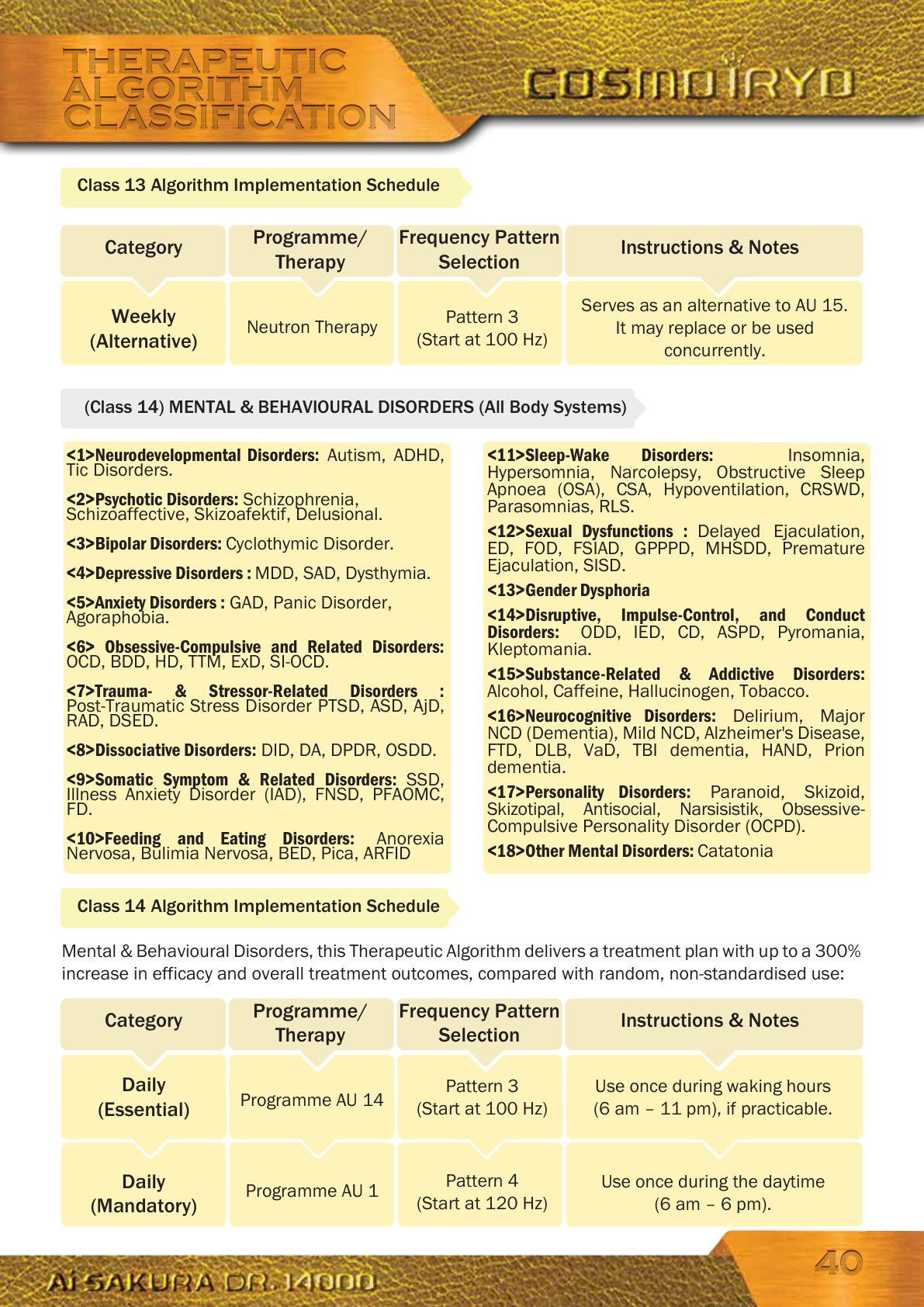
THERAPEUTIC ALGORITHM CLASSIFICATIONTHERAPEUTIC ALGORITHM CLASSIFICATION
Class 13 Algorithm Implementation Schedule
CategoryProgramme/
TherapyFrequency Pattern
SelectionInstructions & Notes
Weekly
(Alternative)Neutron TherapyPattern 3
(Start at 100 Hz)Serves as an alternative to AU 15.
It may replace or be used
concurrently.
<1>Neurodevelopmental Disorders: Autism, ADHD, Tic Disorders.
<2>Psychotic Disorders: Schizophrenia, Schizoaffective, Skizoafektif, Delusional.
<3>Bipolar Disorders: Cyclothymic Disorder.
<4>Depressive Disorders : MDD, SAD, Dysthymia.
<5>Anxiety Disorders : GAD, Panic Disorder, Agoraphobia.
<6> Obsessive-Compulsive and Related Disorders: OCD, BDD, HD, TTM, ExD, SI-OCD.
<7>Trauma- & Stressor-Related Disorders : Post-Traumatic Stress Disorder PTSD, ASD, AjD, RAD, DSED.
<8>Dissociative Disorders: DID, DA, DPDR, OSDD. <9>Somatic Symptom & Related Disorders: SSD, Illness Anxiety Disorder (IAD), FNSD, PFAOMC, FD.
<10>Feeding and Eating Disorders: Anorexia Nervosa, Bulimia Nervosa, BED, Pica, ARFID (Class 14) MENTAL & BEHAVIOURAL DISORDERS (All Body Systems)
<11>Sleep-Wake Disorders: Insomnia,
Hypersomnia, Narcolepsy, Obstructive Sleep
Apnoea (OSA), CSA, Hypoventilation, CRSWD,
Parasomnias, RLS.
<12>Sexual Dysfunctions : Delayed Ejaculation,
ED, FOD, FSIAD, GPPPD, MHSDD, Premature
Ejaculation, SISD.
<13>Gender Dysphoria
<14>Disruptive, Impulse-Control, and Conduct
Disorders: ODD, IED, CD, ASPD, Pyromania,
Kleptomania.
<15>Substance-Related & Addictive Disorders:
Alcohol, Caffeine, Hallucinogen, Tobacco.
<16>Neurocognitive Disorders: Delirium, Major
NCD (Dementia), Mild NCD, Alzheimer's Disease,
FTD, DLB, VaD, TBI dementia, HAND, Prion
dementia.
<17>Personality Disorders: Paranoid, Skizoid,
Skizotipal, Antisocial, Narsisistik, Obsessive-
Compulsive Personality Disorder (OCPD).
<18>Other Mental Disorders: Catatonia
Mental & Behavioural Disorders, this Therapeutic Algorithm delivers a treatment plan with up to a 300%
increase in efficacy and overall treatment outcomes, compared with random, non-standardised use:Class 14 Algorithm Implementation Schedule
Category
Daily
(Mandatory)Programme/
TherapyFrequency Pattern
SelectionInstructions & Notes
Programme AU 1Pattern 4
(Start at 120 Hz)Use once during the daytime
(6 am – 6 pm).
Daily
(Essential)Programme AU 14Pattern 3
(Start at 100 Hz)Use once during waking hours
(6 am – 11 pm), if practicable.
4040
Image placeholder filename: img-41.jpg
• Recommended ratio: portrait 3:4 (or keep original page image)
Page 42
BM

THERAPEUTIC ALGORITHM CLASSIFICATIONTHERAPEUTIC ALGORITHM CLASSIFICATION
Class 14 Algorithm Implementation Sched-
CategoryProgramme/
TherapyFrequency Pattern
SelectionInstructions & Notes
Daily
(Alternative)Cosmotron TherapyPattern 2
(Start at 50 Hz)Serves as an alternative to AU 14. It
may replace or be used concurrently.
For first-time users, commence at
5000V for 30 minutes.
Weekly
(Booster)Programme AU 14Pattern 2
(Start at 50 Hz)Administer twice per week.
Weekly
(Alternative)Neutron TherapyPattern 4
(Start at 120 Hz)Serves as an alternative to AU 14.
It may replace or be used
concurrently.
<1> Complications from Surgery or Medication:
<a>From Surgery: Wound infections, internal
scarring (adhesions), fluid collection (seroma), or
bleeding after an operation.
<b>From Medicines: Harmful side effects (e.g.,
liver damage, severe skin reactions).
<c> From Diagnostic Tests or Treatments: Kidney
problems from contrast dye used in scans, or
tissue damage from radiation therapy.
<2> Problems After an Organ or Tissue Transplant:
<a> The donor cells attack the recipient's body
(GVHD).
<b> The recipient's body rejects the transplanted
organ/tissue.
<c> Development of a lymph node disorder (PTLD) or
serious infections due to the strong anti-rejection
medicines. (15.A) COMPLICATIONS OF MEDICAL CARE AND ENVIRONMENTAL EXPOSURE (Class 15) DISORDERS OF EXOGENOUS AETIOLOGY AND SENESCENCE
<3> Poisoning or Harm from Non-Medical Substances:
<a> Chemical Poisoning: From pesticides, lead, or
mercury.
<b> Animal/Plant Toxins: Bites, stings, or ingestion
of poisonous plants.
<c> Environmental Exposure: To harmful
substances in the air, water, or workplace.
<4> Problems with Medical Implants or Devices:
<a> Implant Failure: Artificial joints or breast
implants that break, wear out, or move.
<b> Device Malfunction: Problems with pacemakers,
defibrillators, or brain shunt devices.
<5> Long-Term Effects After Treatment or Injury:
<a> Physical Changes: Joint stiffness
(contractures), scars, or thickened tissue
(fibrosis).
<b> Chronic Pain: Persistent pain that started
after a procedure or injury.
<1> Geriatric Syndromes: Frailty , Anorexia of
Ageing , Urinary Incontinence in the Elderly .
<2> Cognitive & Functional Decline: MCI,
Age-Associated Memory Impairment , Functional
Decline in Activities of Daily Living (ADLs) . (15.B) GERIATRIC DISORDERS AFFECTING INDIVIDUALS >65 YEARS
<3> Multimorbidity & Polypharmacy Issues:
Management of Multiple Chronic Conditions
, Adverse Drug Reactions due to Polypharmacy.
<4> Sensory & Mobility Impairments in the Elderly:
Presbycusis , Presbyopia , Age-Related Mobility
Limitations .
4141
Image placeholder filename: img-42.jpg
• Recommended ratio: portrait 3:4 (or keep original page image)
Page 43
BM

THERAPEUTIC ALGORITHM CLASSIFICATIONTHERAPEUTIC ALGORITHM CLASSIFICATION
Disorders Of Exogenous Aetiology and Senescence, this Therapeutic Algorithm delivers a treatment
plan with up to a 300% increase in efficacy and overall treatment outcomes, compared with random,
non-standardised use:Class 15 Algorithm Implementation Schedule
Category
Daily
(Mandatory)Programme/
TherapyFrequency Pattern
SelectionInstructions & Notes
Programme AU 2Pattern 3
(Start at 100 Hz)Use once during the daytime
(6 am – 6 pm).
Daily
(Essential)Programme AU 12Pattern 1
(Start at 40 Hz)Use once during waking hours
(6 am – 11 pm), if practicable.
Daily
(Alternative)Electron TherapyPattern 4
(Start at 120 Hz)Serves as an alternative to AU 12. It
may replace or be used concurrently.
For first-time users, commence at
6000V for 30 minutes.
Weekly
(Booster)Programme AU 6Pattern 4
(Start at 120 Hz)Administer twice per week.
Weekly
(Alternative)Neutron TherapyPattern 2
(Start at 50 Hz)Serves as an alternative to AU 6.
It may replace or be used
concurrently.
<1> General Symptoms: Prolonged/unspecified
fever , Unexplained weight loss, Severe fatigue
and malaise, Oedema , Drenching night sweats ,
Intolerance to heat or cold , Loss of appetite,
Persistent low-grade fever .
<2> Neurological, Cognitive & Sensory Symptoms :
Persistent headaches, Dizziness, Vertigo ,
fainting spells , Brain Fog , Memory problems ,
Numbness or tingling sensations , Unexplained
tremors , Tinnitus , Unexplained loss of smell or
taste . <3> Cardiorespiratory Symptoms : Non-specific
chest pain/discomfort, Palpitations, Shortness
of breath (dyspnoea) at rest or on exertion ,
Persistent dry or productive cough, Coughing
blood (haemoptysis), Wheezing ,
Chest tightness .
<4> Digestive & Abdominal Symptoms : Chronic or
recurrent abdominal pain, Difficulty swallowing/
dysphagia, Persistent heartburn/indigestion
Chronic nausea, Unexplained vomiting ,
Abdominal bloating/ distension, Altered bowel
habits - diarrhoea/constipation , Rectal
bleeding .
(16.A) UNEXPLAINED SYMPTOMS, SIGNS AND CLINICAL FINDINGS, PERSISTENT DESPITE
MULTIPLE DIAGNOSES.
(CLASS 16) SYSTEMIC DISORDERS OF UNCERTAIN OR COMPLEX ORIGIN
4242
Image placeholder filename: img-43.jpg
• Recommended ratio: portrait 3:4 (or keep original page image)
Page 44
BM

THERAPEUTIC ALGORITHM CLASSIFICATIONTHERAPEUTIC ALGORITHM CLASSIFICATION
THERAPEUTIC ALGORITHM CLASSIFICATIONTHERAPEUTIC ALGORITHM CLASSIFICATION
Systemic Disorders Of Uncertain Or Complex Origin , this Therapeutic Algorithm delivers a treatment
plan with up to a 300% increase in efficacy and overall treatment outcomes, compared with random,
non-standardised use:Class 16 Algorithm Implementation Schedule
Category
Daily
(Mandatory)Programme/
TherapyFrequency Pattern
SelectionInstructions & Notes
Programme AU 2 Programme AU 2 Use once during the daytime
(6 am – 6 pm).
Daily
(Essential)Programme AU 12Pattern 4
(Start at 120 Hz)Use once during waking hours
(6 am – 11 pm), if practicable.
Daily
(Alternative)Electron TherapyPattern 3
(Start at 100 Hz)Serves as an alternative to AU 12. It
may replace or be used concurrently.
For first-time users, commence at
6000V for 30 minutes.
Weekly
(Booster)Programme AU 16Pattern 3
(Start at 100 Hz)Administer twice per week.
Weekly
(Alternative)Neutron TherapyPattern 2
(Start at 50 Hz)Serves as an alternative to AU 16
It may replace or be used
concurrently.
<1> Systemic Autoimmune Rheumatic Diseases
(Non-Organ Specific): Sjögren’s syndrome,
scleroderma, MCTD, polymyositis,
dermatomyositis.
<2> Systemic Inflammatory Response Syndromes:
Sepsis and septic shock, SIRS, cytokine release
syndrome.
<3> Systemic Vasculitides (Affecting Multiple
Vascular Territories): Polyarteritis nodosa (PAN), (16.B) DEFINED MULTISYSTEM DISORDERS
GPA, EGPA, MPA.
<4> Systemic Infiltrative & Deposition Disorders:
Sarcoidosis, amyloidosis (systemic), histiocytosis.
<5> Polysymptomatic Illnesses (Without Dominant
Single Organ Pathology): Chronic fatigue syndrome
/ myalgic encephalomyelitis (CFS/ME),
fibromyalgia, multiple chemical sensitivity,
persistent physical symptoms of unknown origin.
<5> Musculoskeletal, Skin & Local Symptoms : Wide-
spread muscle or joint pain , Persistent localised
pain , Unexplained skin rashes or lesions ,
Chronic itching -Pruritus , Hives , Localised
swelling - oedema), Unexplained hair loss,
Changes in nail appearance .<6> Abnormal Findings On Clinical Examination :
Unexplained lymph node enlargement
, Murmurs , Abnormal lung sounds , Palpable
abdominal mass , Enlarged liver or spleen ,
Unexplained neurological signs , Incidental
Findings on Diagnostic Scans/X-rays .
(16.A) UNEXPLAINED SYMPTOMS, SIGNS AND CLINICAL FINDINGS, PERSISTENT DESPITE
MULTIPLE DIAGNOSES.
4343
Image placeholder filename: img-44.jpg
• Recommended ratio: portrait 3:4 (or keep original page image)
Page 45
BM
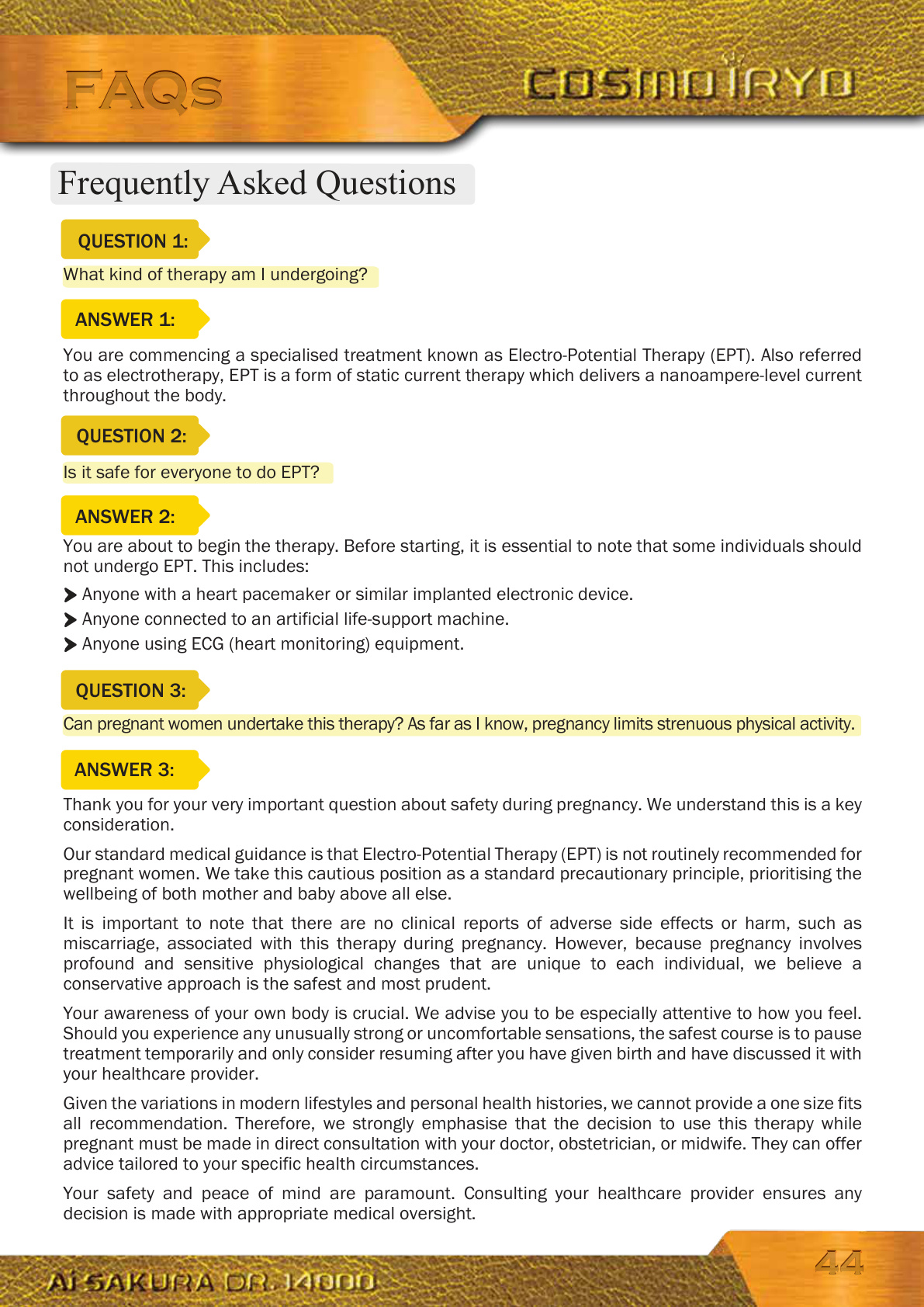
What kind of therapy am I undergoing?
You are commencing a specialised treatment known as Electro-Potential Therapy (EPT). Also referred
to as electrotherapy, EPT is a form of static current therapy which delivers a nanoampere-level current
throughout the body.
Thank you for your very important question about safety during pregnancy. We understand this is a key
consideration.
Our standard medical guidance is that Electro-Potential Therapy (EPT) is not routinely recommended for
pregnant women. We take this cautious position as a standard precautionary principle, prioritising the
wellbeing of both mother and baby above all else.
It is important to note that there are no clinical reports of adverse side effects or harm, such as
miscarriage, associated with this therapy during pregnancy. However, because pregnancy involves
profound and sensitive physiological changes that are unique to each individual, we believe a
conservative approach is the safest and most prudent.
Your awareness of your own body is crucial. We advise you to be especially attentive to how you feel.
Should you experience any unusually strong or uncomfortable sensations, the safest course is to pause
treatment temporarily and only consider resuming after you have given birth and have discussed it with
your healthcare provider.
Given the variations in modern lifestyles and personal health histories, we cannot provide a one size fits
all recommendation. Therefore, we strongly emphasise that the decision to use this therapy while
pregnant must be made in direct consultation with your doctor, obstetrician, or midwife. They can offer
advice tailored to your specific health circumstances.
Your safety and peace of mind are paramount. Consulting your healthcare provider ensures any
decision is made with appropriate medical oversight.Can pregnant women undertake this therapy? As far as I know, pregnancy limits strenuous physical activity.You are about to begin the therapy. Before starting, it is essential to note that some individuals should
not undergo EPT. This includes:Is it safe for everyone to do EPT?QUESTION 1:
ANSWER 1:
QUESTION 2:
ANSWER 2:
QUESTION 3:
ANSWER 3:Anyone with a heart pacemaker or similar implanted electronic device.
Anyone connected to an artificial life-support machine.
Anyone using ECG (heart monitoring) equipment.
FAQsFAQs
Frequently Asked Questions
4444
Image placeholder filename: img-45.jpg
• Recommended ratio: portrait 3:4 (or keep original page image)
Page 46
BM

Diagram 1 for FAQS
The user not undergoing therapy stands
while holding the tester and touches the
tester towards the Sitting/Sleeping Pad.How will I know the therapy is starting? What will I feel? Will I feel anything?

Please do not worry; it is perfectly all right. Your entire body is now conducting the EPT current, which
can reach a maximum of 14,000 Volts. This is an EPT current tester. As you can see, there is no EPT
energy on me, hence the tester does not beep or light up. If you are undergoing therapy, the tester will
beep and light up when placed on your body. This proves there is an EPT current on your hand,
shoulder, and even your legs.
Yes, there is a verification method referred to as a feel and hearing test. The first method involves
touching the fingertips of a person receiving the therapy with those of a person who is not. You will feel
a static electric shock upon contact during this hand contact test. Similar to an electrical conductor, you
may also experience a mild shock if you touch an iron or metal object. While this is not dangerous, it is
not recommended. It is the same type of occasional shock you might feel when touching a moving
trolley or a doorknob.
The second method involves pressing a laminated sheet between the palms of a person undergoing the
therapy and one who is not. You will feel strong vibrations and hear a loud noise if the therapy reaches
its maximum of 14,000 volts. This feel and hearing test can also be performed by touching any two
corresponding body parts between the two individuals.
The sensations you experience during the test occur because our therapy applies a high voltage (up to
14,000 volts) at a frequency of 40 Hz to 120 Hz, which means it vibrates 40 to 120 times per second.
It is not only conducted on your hands, shoulders, and legs, but the EPT current also passes through
your heart and even your bone marrow. As of right now, you are already very relaxed and undergoing the
full-body therapy.Is there another way for me to make sure that I am undergoing therapy, and why did I feel that way while
I was doing the feel and hearing test when the therapy was starting?QUESTION 4:
ANSWER 4:
QUESTION 5:
ANSWER 5:
Diagram 2 for FAQS
The user sits on the Sitting/Sleeping Pad
while holding the tester and touching the
tester towards the surrounding objects.
Frequently Asked Questions
FAQsFAQs
88/gid0006988888
88/gid0006988888
4545
Image placeholder filename: img-46.jpg
• Recommended ratio: portrait 3:4 (or keep original page image)
Page 47
BM

4646
Understanding the Principles of Electro-Potential Therapy (EPT)
What are the main functions of the therapy I am undergoing, and how do they work?
To understand how it works, it is helpful to first recognise the primary factors that can disrupt our health:Electro-Potential Therapy (EPT) is designed to support your body’s health by addressing core imbalances
that can arise from modern life. The treatment is based on four key therapeutic functions, which work
together to restore your body's natural state of wellbeing.
In summary, Electro-Potential Therapy takes a holistic approach, seeking to cleanse, balance,
strengthen, and revitalise your body's core systems to support overall health and recovery.These factors can negatively impact your body systems, potentially leading to issues such as congested
and acidic blood vessels, a dysregulated nervous system, a weakened immune response, and a
diminished natural healing capacity. EPT aims to counter these effects through the following
four functions:QUESTION 6:
ANSWER 6:
Poor Nutrition
Mental and Physical Stress
Cleansing the
Blood Vessels
Regulating the
Nervous System
Strengthening the
Immune System
Enhancing the
Body's Natural
Healing CapacityEPT works to cleanse and decongest the circulatory system. By helping to
clear blockages and reduce acidity within the blood vessels, the
therapy promotes cleaner, more free-flowing blood. A key outcome is the
support of a healthy, slightly alkaline blood pH, which is a natural state for
optimal bodily function.
The therapy assists in balancing and regulating an overactive or imbalanced
nervous system. Many common issues, such as constipation, can stem from
nerve signals that cause muscles to contract and relax irregularly. EPT helps
to recalibrate these nerve signals. In the example of constipation, it supports
the restoration of a balanced rhythm between intestinal contraction
(governed by the positive nervous system) and expansion (governed by the
negative nervous system), thereby promoting normal digestive function.
A core function of EPT is to reinforce and strengthen your body's natural
immune defences. A more robust immune system is better equipped to resist
illness and infection. By enhancing your immune response, the therapy helps
your body become more resilient and less susceptible to common ailments.
Finally, EPT acts to reactivate and enhance your body's innate self-repair
mechanisms. While the human body possesses a powerful natural healing
system, the cumulative effects of stress, diet, and environment can impair its
function. This therapy works to restore your body's systems to their original,
efficient state, thereby facilitating and accelerating your natural healing
processes.
Frequently Asked Questions
Lack of Exercise
Environmental Pollution
FAQsFAQs
Image placeholder filename: img-47.jpg
• Recommended ratio: portrait 3:4 (or keep original page image)
Page 48
BM
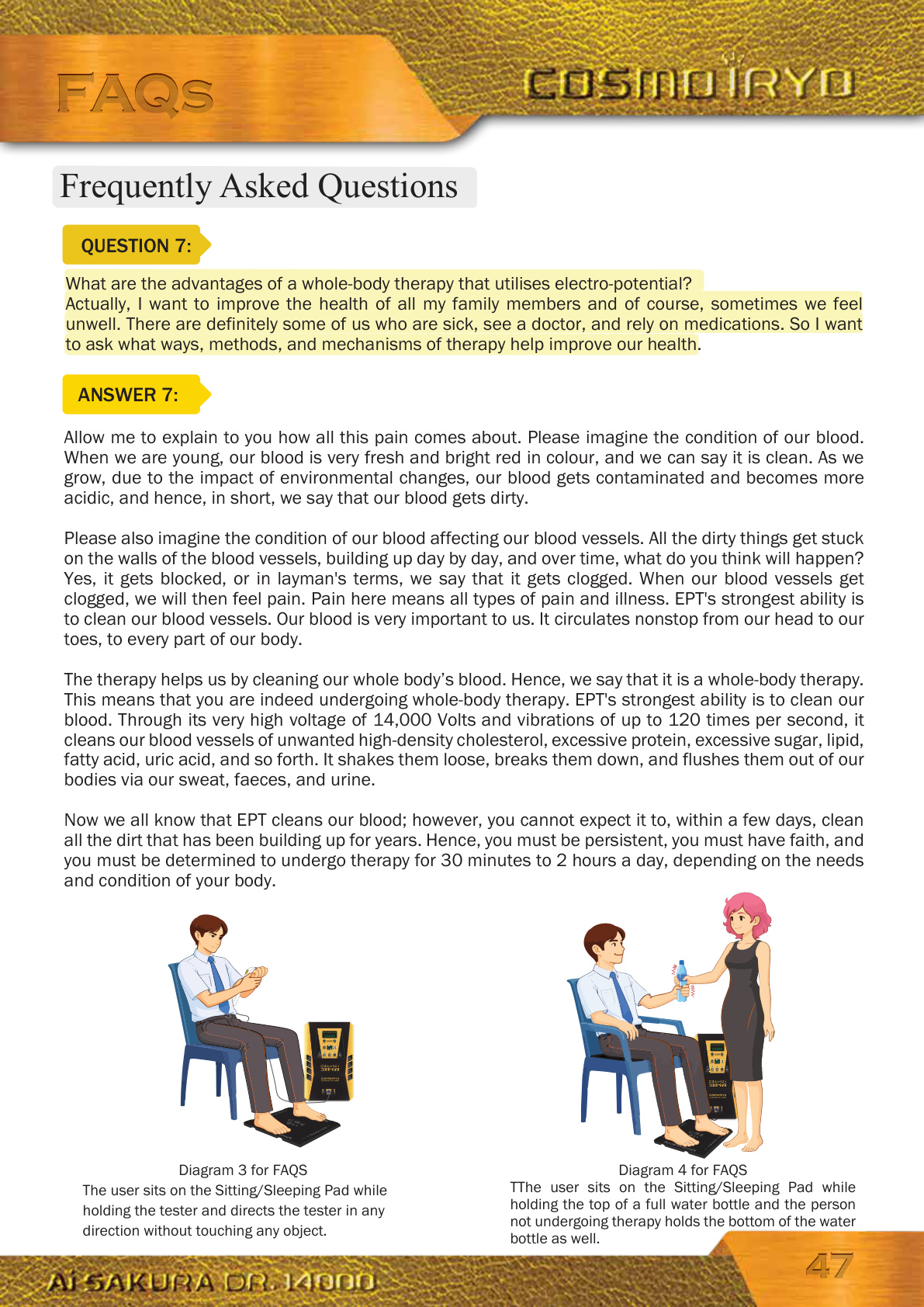
Allow me to explain to you how all this pain comes about. Please imagine the condition of our blood.
When we are young, our blood is very fresh and bright red in colour, and we can say it is clean. As we
grow, due to the impact of environmental changes, our blood gets contaminated and becomes more
acidic, and hence, in short, we say that our blood gets dirty.
Please also imagine the condition of our blood affecting our blood vessels. All the dirty things get stuck
on the walls of the blood vessels, building up day by day, and over time, what do you think will happen?
Yes, it gets blocked, or in layman's terms, we say that it gets clogged. When our blood vessels get
clogged, we will then feel pain. Pain here means all types of pain and illness. EPT's strongest ability is
to clean our blood vessels. Our blood is very important to us. It circulates nonstop from our head to our
toes, to every part of our body.
The therapy helps us by cleaning our whole body’s blood. Hence, we say that it is a whole-body therapy.
This means that you are indeed undergoing whole-body therapy. EPT's strongest ability is to clean our
blood. Through its very high voltage of 14,000 Volts and vibrations of up to 120 times per second, it
cleans our blood vessels of unwanted high-density cholesterol, excessive protein, excessive sugar, lipid,
fatty acid, uric acid, and so forth. It shakes them loose, breaks them down, and flushes them out of our
bodies via our sweat, faeces, and urine.
Now we all know that EPT cleans our blood; however, you cannot expect it to, within a few days, clean
all the dirt that has been building up for years. Hence, you must be persistent, you must have faith, and
you must be determined to undergo therapy for 30 minutes to 2 hours a day, depending on the needs
and condition of your body.What are the advantages of a whole-body therapy that utilises electro-potential?
Actually, I want to improve the health of all my family members and of course, sometimes we feel
unwell. There are definitely some of us who are sick, see a doctor, and rely on medications. So I want
to ask what ways, methods, and mechanisms of therapy help improve our health.QUESTION 7:
ANSWER 7:
Diagram 3 for FAQS
The user sits on the Sitting/Sleeping Pad while
holding the tester and directs the tester in any
direction without touching any object.Diagram 4 for FAQS
TThe user sits on the Sitting/Sleeping Pad while
holding the top of a full water bottle and the person
not undergoing therapy holds the bottom of the water
bottle as well.
Frequently Asked Questions
88/gid0006988888
88/gid0006988888
FAQsFAQs
4747
Image placeholder filename: img-48.jpg
• Recommended ratio: portrait 3:4 (or keep original page image)
Page 49
BM

Yes, the therapy can be suitable for children, elderly individuals, and pets. However, important
adjustments are necessary for their safety and comfort, as their bodies respond differently compared
to the average adult.
For children and the elderly, particularly those aged 80 and above, a specialised and cautious approach
is essential. Their physical condition, including metabolic rate and potential sensitivity, differs
significantly from that of adolescents and adults. To prevent any strong or overwhelming reaction, it is
vital to begin with the lowest voltage setting and introduce the therapy very gradually under close
supervision. This allows their systems to adapt gently.
For pets, the principle of using a very low-intensity setting also applies. A low voltage is typically
sufficient and appropriate due to their smaller size and different physiology. It is important to observe
your pet closely for comfort during initial sessions.
In all cases, starting gently and carefully monitoring the response is the key to a safe and positive
experience. We recommend consulting with your healthcare provider for specific guidance relating to a
child or elderly family member.Can a pet, child, or person who is very elderly undertake this therapy?QUESTION 8:
ANSWER 8:
It is possible to experience some effects after your first session or even after a few sessions of therapy.
People sometimes feel a little sleepy, tired, or lethargic. Areas of pain can become more sensitive, while
other pains may lessen. These sensations can change after a session. If you do experience this, it is a
positive sign that the EPT is beginning to address the underlying cause of the issue. Think of it like
having a splinter: it hurts, but to remove it, the area must be cleaned, which may be briefly more painful.
The same principle applies here. For many, the pain reduces after perhaps three or four sessions.
However, as everyone responds differently, some might require seven or eight sessions or more.As far as I know, any health treatment comes with a variety of reactions or healing crises. Are there any
reactions or healing crises if I am doing EPT?QUESTION 9:
ANSWER 9:
Frequently Asked Questions
FAQsFAQs
4848
Image placeholder filename: img-49.jpg
• Recommended ratio: portrait 3:4 (or keep original page image)
Page 50
BM

We would recommend that you perform a urine test. As you approach your seventh therapy session,
you can try a simple experiment. Collect your first urine of the day in a clear container. Let it sit
undisturbed for three to five hours so the contents can settle. Then, examine it. You will likely see three
distinct layers. The top layer often contains a thin, foil-like film. The middle layer may be a cloudy,
whitish, jelly-like substance. The bottom layer will frequently show sandy, grainy sediments. These are
the waste products and deposits from your blood vessels that the therapy has helped your body expel
through urine.
Not everyone will observe these exact results. Some people instead notice that they sweat more or that
their stools have a stronger odour, as individuals eliminate waste in different ways. The key is to
continue your sessions consistently through to the seventh day and perform this personal urine test to
see the effects for yourself.You say EPT helps clean blood vessels. Explain how all dirt is removed from the body in more detail by
using EPT. QUESTION 10:
ANSWER 10:
Diagram 5 for FAQS
A Urine Test is a small experiment
as explained in detail above.
FAQsFAQs
Frequently Asked Questions
4949
Oil-like Layer
Jelly-like (Colloidal) Layer
Sand-like Sediment
Image placeholder filename: img-50.jpg
• Recommended ratio: portrait 3:4 (or keep original page image)
Page 51
BM

FAQsFAQs
Frequently Asked Questions
A healing crisis is a temporary increase in symptoms upon starting EPT. You might also hear it called a
detox reaction or a cleansing process. It refers to a period where symptoms may briefly feel worse
before they begin to improve.
When clearing waste from your blood vessels, your body undergoes changes that can affect how you
feel. This process releases various waste products. Your body may signal that it is cleansing itself
through signs such as fatigue, poor sleep, or skin changes.
As your body detoxifies, it is common to experience some flu-like sensations, such as headaches,
muscle aches, sweating, or nausea. You might also feel fatigued, irritable, or notice temporary skin
irritation, as the skin is one pathway the body uses to remove impurities.
This reaction is normal, usually requires no special treatment, and will often pass within a day.What is a reaction or healing crisis, and why do these reactions or healing crises occur?
While using the therapy, some people experience only very mild reactions, or these may occur during
sleep, so they are hardly noticeable. Others may have reactions during the application itself. Most
commonly, reactions appear 2–3 days afterwards or more than 10 days later. Such a reaction will
generally begin to fade after 1–2 days, though some people may need 7–10 days for it to disappear
completely. The reaction can be relatively strong if symptoms are severe, the person is older, or the
body is weaker; in these cases, it may last longer and occur more frequently.When will the reaction occur?QUESTION 11:
ANSWER 11:
QUESTION 12:
ANSWER 12:
88/gid0006988888
Diagram 6 for FAQS
The user sits on the Sitting/Sleeping Pad and places a hand on one
laminated side of the Acupoint Chart. At the same time, a second person
places a hand on the other side of the chart. Touching the same point on
opposite sides produces a noticeable vibration.
5050
Image placeholder filename: img-51.jpg
• Recommended ratio: portrait 3:4 (or keep original page image)
Page 52
BM

FAQsFAQs
Frequently Asked Questions
The EPT treatment device is a medical instrument that works on the whole body. Its way of working is
different from other medical devices and general health products. It mainly helps to adjust your body
from the inside out, meaning it follows a medical approach that works from your core systems to the
surface.
Most people begin to notice reactions after two to three uses, though for some these may appear later.
If you experience what we call a healing response, which is a temporary temporary flare-up of symptoms,
please do not be alarmed. This is often a sign that deeper, underlying issues are being addressed. While
this phase can be uncomfortable, it generally indicates the first step towards improvement.
Please be reassured and continue using the device as recommended. Usually within three to fifteen
days, but sometimes longer, the symptoms will gradually ease and fade. Once this response passes,
your body will steadily begin to feel better.What are the basic things I need to do or respond to when a reaction occurs?
Reactions can occur in specific locations, which we refer to as reaction positions. Primarily, these are
areas where your body is currently working to heal or rebalance itself. You may typically notice a
response in one of three key areas.
Firstly, reactions often appear at the original suffering position. This means the specific site of a
previous or existing illness, injury, or point of chronic pain. For instance, if you have had lower back pain,
you might feel a temporary recurrence or intensification of discomfort in that exact area as the therapy
begins to address the underlying issue.
Secondly, a reaction can manifest at what is termed a hidden morbid position. This refers to a site of
latent or low-level dysfunction that you may not have been consciously aware of previously. The therapy
can bring these underlying and dormant imbalances to the surface, which may cause temporary
symptoms in an area that felt normal before. This process is generally a sign that the treatment is
identifying and engaging with root causes that were not immediately obvious.
Finally, the reaction might not be in one specific position but could involve the reappearance or
exposure of a general symptom. This means you could experience a temporary return of older systemic
symptoms, such as fatigue, headache, or mild fever, as your body's systems work to regulate and
detoxify. This is a normal part of the holistic adjustment process.
It is important to understand that the location and nature of these reactions are highly individual. They
are positive indicators that the treatment is initiating a deep, core level healing process, working from
the inside out. The presence of a reaction in any of these positions signifies that your body is actively
responding to the therapy.Where are the reaction positions? QUESTION 13:
ANSWER 13:
QUESTION 14:
ANSWER 14:
5151
Image placeholder filename: img-52.jpg
• Recommended ratio: portrait 3:4 (or keep original page image)
Page 53
BM

FAQsFAQs
Frequently Asked Questions
QUESTION 15:
ANSWER 15:What do the temporarily common reactions include?
During the course of therapy, it is common to experience temporary reactions as your body adjusts and
begins its healing process. These responses vary depending on your individual health background. The
following list outlines common conditions and the temporary reactions associated with them:
You may experience a recurrence of pain, numbness, stiffness, or swelling in
the affected joints.
Insomnia Rheumatism
or Arthritis
While many people experience deeper sleep, some may temporarily
experience more pronounced insomnia.
Constipation Bowel habits may change, leading to either slightly loose stools or a temporary
period of constipation.
There may be a temporary presence of blood in the stool. Hemorrhoids
Reactions can include headaches, dizziness, and a feeling of general fatigue.
Indigestion Vegetative
Nerve Functional
Disturbance
Symptoms may include slightly loose stools or general digestive discomfort.
Dermatosis You might notice temporary skin itching (pruritus).
The body may react with skin redness (erythema) and increased thirst as it
processes substances.Long-term
Medications or
Toxic Overload
Possible reactions include dizziness, a heavy feeling in the nose, and temporary
fluctuations in your blood pressure.Hypertension
You may feel dizzy and experience blurred vision.
Heart Disease Hypotension
Temporary sensations can include a tight feeling in the chest, palpitations,
or temporary irregularities in heart rhythm.
DiabetesBlood sugar levels may become unstable, with values possibly rising for a
short period. Some swelling (oedema) in the hands and feet may also occur.
Reactions can include episodes of vomiting, skin redness, or mouth ulcers
(ulcerative stomatitis).Liver Disease
5252
Image placeholder filename: img-53.jpg
• Recommended ratio: portrait 3:4 (or keep original page image)
Page 54
BM

Gynaecological
Conditions Kidney Disease
Acidic
Constitution
Please remember that these reactions are generally a positive sign that the therapy is engaging with
your body's underlying conditions. They are typically transient and will subside as your body continues
to rebalance.
Why do healing crisis symptoms vary from person to person?
The symptoms experienced during a healing crisis can differ significantly between individuals, which is
a normal and expected part of the therapeutic process. This variation occurs because each person's
body and health circumstances are unique. The specific reaction you may have is influenced by several
key personal factors.
Primarily, the length of time you have had a condition and the severity of the illness play crucial roles. A
long-standing or more serious health issue may prompt a different response compared to a recent or
milder one. Furthermore, your personal physical constitution, which is your body's inherent strength and
balance, greatly affects how you react. Your age is another important factor, as the body's natural
capacity to process and respond to treatment can change over time.
Due to these variables, some people experience stronger or more pronounced reactions, while others
notice only very slight changes. Similarly, these symptoms may last for a relatively longer period for
some, whereas others might recover completely within just one to two days. The frequency of reactions
can also vary.
It is important to understand that this entire spectrum of responses, whether strong, slight, quick, or
prolonged, falls within the range of a normal reaction to the therapy. It indicates that your body is
actively engaging in a deep, core-level adjustment, working from the inside out to restore balance.QUESTION 16:
ANSWER 16:
FAQsFAQs
Frequently Asked Questions
5353
You may notice temporary changes in urine colour, volume, frequency, and
odour.
This may involve temporary irregularities in menstrual flow or cycle length.
Common temporary reactions include general fatigue, very deep sleep, and
pronounced thirst.
Image placeholder filename: img-54.jpg
• Recommended ratio: portrait 3:4 (or keep original page image)
Page 55
BM

FAQsFAQs
Frequently Asked Questions
It is very positive that you wish to continue with the therapy. To help manage and reduce any healing
crisis reactions, we have two straightforward and essential recommendations.
Firstly, we strongly advise you to ensure you get more rest than usual if you experience a reaction.
Allowing your body additional time to rest and recuperate is fundamentally supportive. It reduces
external physical and mental demands, enabling your system to focus its energy on the internal healing
and adjustment processes that the therapy has initiated.
Secondly, it is crucial to drink more water. Increasing your water intake is highly favourable for
optimising your body's metabolism and natural detoxification functions. Adequate hydration helps your
organs function more efficiently, facilitates the elimination of toxins and byproducts, and can
significantly assist in relieving the intensity and duration of the reaction.
Together, these simple actions of prioritising rest and increasing hydration provide direct support to
your body's innate healing mechanisms. This approach helps to moderate the reactions, making them
more manageable as you progress through your treatment.I want to continue therapy regardless of the reactions. What is an easy way to reduce the reactions?QUESTION 17:
ANSWER 17:
A healing crisis is a recognised part of the therapeutic process for many individuals. The appropriate
measures depend entirely on the nature and severity of your specific reaction. Please follow this
guidance to manage the response safely and effectively. For a relatively light reaction: You should
continue the therapy as normal. There is no cause for concern. These mild symptoms are typically
transient and will subside of their own accord within a few days.
For a serious reaction: It is advisable to shorten the duration of your daily therapy session. This gives
your body a temporary respite while allowing the treatment to continue. Once the intense reaction has
passed and symptoms have begun to subside, you may gradually return to the standard session length.
For a very serious reaction, particularly in elderly or frail individuals: The recommended action is to stop
using the therapy completely for one to two days. This pause allows your system to settle. You may then
restart with shorter sessions, as described above, before building back to the full duration. In all cases
where a reaction is severe, persistent, or causes concern, you must consult your doctor. A medical
examination is essential. A prolonged healing crisis can sometimes indicate a previously hidden or
undiagnosed condition that requires separate medical attention.
Important Note on Pre-existing Diagnosis: If you experience serious pain or symptoms, it is vital to have
a proper medical diagnosis before beginning any therapy. You cannot effectively manage or monitor a
condition if it has not been identified. A diagnosis, supported by medical reports, provides a clear
baseline. This knowledge allows you and your healthcare providers to accurately assess your progress
and the effectiveness of any treatment, ensuring your safety and appropriate care.What measures shall be taken when the healing crisis happens? QUESTION 18:
ANSWER 18:
5454
Image placeholder filename: img-55.jpg
• Recommended ratio: portrait 3:4 (or keep original page image)
Page 56
BM

FAQsFAQs
Frequently Asked Questions
It is completely understandable to feel apprehensive about potential reactions. While there is no
absolute guarantee that reactions can be entirely minimised or avoided, as each individual's body
responds uniquely, the following structured approach is designed to introduce the therapy gently. This
method, based on extensive records and observations of users, significantly reduces the likelihood of
strong reactions by allowing your body to adapt gradually.
General Principle: The key is to start slowly and increase intensity only when your body is ready. A useful
comparison is beginning a new exercise regimen; you would start with light, short sessions before
progressing to heavier or longer workouts to prevent injury and allow your body to adapt.
Structured Approach for First-time and Inexperienced Users:
For your safety and comfort, it is crucial to follow this phased protocol. Never exceed a total therapy
duration of one hour per day during your first month.QUESTION 19:
ANSWER 19:I am scared of all those reactions and what should I do to minimise or avoid all those reactions?
Step 1: Beginner Phase
Typical Duration: The standard period for most individuals is the first 10 days.
Voltage Strength: Use the beginner level settings: 3000, 5000, or 6000 Volts.
Therapy Time: Start with a maximum cumulative total of one hour per day. This can be split into
sessions, for example, two 30-minutes sessions.
Goal: This phase allows your body to become familiar with the therapy's effects at its mildest level.
Ensure you no longer experience any adverse reactions before considering progression to the next
phase.
Special Consideration: For some very elderly or sensitive users who cannot tolerate the beginner
phase voltages, it is advisable to commence with a lower pre-beginner phase at 2000 Volts.
Step 2: Middle Phase
Typical Duration: The standard period for progression is typically days 11 to 20 for most users.
Voltage Strength: Only if your body has adapted well with no significant reactions, you may progress
to middle level settings: 8000, 9000, or 11000 Volts.
Therapy Time: Maintain the maximum of one hour per day.
Important: Only proceed to this step if you feel your condition and body tolerance are suitable after
the first 10 days. You must be free of any reactions before advancing further. If you experience a
moderate or strong reaction, please remain at this phase until your body is fully prepared
to progress.
5555
Image placeholder filename: img-56.jpg
• Recommended ratio: portrait 3:4 (or keep original page image)
Page 57
BM

Yes, you can. The therapy is designed to be complementary and does not inherently conflict with
conventional medical treatments. It is generally safe to use alongside medications and most medical
procedures. However, for your safety and comfort, please observe the following important guidelines.
If you are planning to begin the therapy, it is advisable to avoid starting it while you are simultaneously
recovering from a medical procedure that is expected to cause a strong physical reaction or requires
significant healing time. For example, this includes the period immediately after major surgery, during
a severe allergic reaction to a medication, or while undergoing other intensive treatments. It is best to
allow your body to recover fully from the initial impact and stress of the medical procedure before
introducing the therapy. This point is particularly important for first-time users, to allow your system to
stabilise.QUESTION 20:
ANSWER 20:Can I use the therapy and at the same time undergo a medical procedure and/or take medication
prescribed by my doctor?What to Do If You Experience a Reaction:
If you notice a strong reaction, you can immediately adjust your routine. Reduce your daily therapy time
from one hour to 30 minutes, or decrease the frequency from twice to once a day. This adjustment will
help your body settle and continue the adaptation process more comfortably.
Who Should Follow This Guide:
This protocol is not only mandatory for first-time users but is also highly recommended for anyone who
has not used the therapy for a long time or does not use it frequently, as the body may need to readapt.
By carefully adhering to this gradual, step-by-step plan, you can confidently begin your therapy with a
greatly reduced risk of experiencing strong reactions, allowing you to focus on the benefits of the
treatment.Critical Safety Instructions:
1.
2.Do not use the AUTOMODE within the first month. Manual control allows you to manage the
 intensity precisely.
Never exceed two hours of therapy in a single day during the initial month, as this can overwhelm
your body's ability to adapt and cause strong, unpleasant reactions.
FAQsFAQs
Step 3: Intensive Phase
Typical Duration: This phase commonly applies from day 21 to day 30 for most users.
Voltage Strength: The intensive level settings (12000, 13000, 14000 Volts) are only to be used
from day 21 onwards, and strictly only if your body has experienced no adverse reactions in the
previous phases.
Therapy Time: Continue to adhere to the one hour daily maximum.
Next Step: Once you are comfortable and stable in this phase, you may then begin using the
AUTOMODE setting.Frequently Asked Questions
5656
Image placeholder filename: img-57.jpg
• Recommended ratio: portrait 3:4 (or keep original page image)
Page 58
BM

Diagram 7 for FAQS
In the Neutron Therapy mode, the user not undergoing
therapy stands while holding the fluorescent light bulb
and touches the light bulb towards the Sitting/Sleeping Pad.Diagram 8 for FAQS
In Neutron Therapy, the user sits on the Sitting/Sleeping Pad
while holding the end of a fluorescent light bulb, and
the person not undergoing therapy holds the other
end of the light bulb as well.
FAQsFAQs
Frequently Asked Questions
Yes, but this should only be done with your doctor's explicit consent and guidance. As you adopt a
healthier lifestyle and engage in therapies that support your wellbeing, it is natural for your condition to
gradually improve. For instance, if readings for diabetes or high blood pressure show consistent and
sustained reduction, your doctor may advise reducing your medication accordingly.
When your health improves, any adjustment to your medication should be made gradually and under
careful medical supervision. Your doctor may recommend a planned, step-by-step reduction in your
medication dosage to safely reflect your improved health.
It is very important that you do not reduce the dose or stop taking your medication abruptly or without
proper medical supervision. Doing so could cause a strong and potentially harmful reaction. Always
follow your doctor’s instructions to ensure your continued safety and recovery.
 Can I stop taking medications prescribed by my doctor when my condition improves? QUESTION 21:
ANSWER 21:
88/gid0006988888
Regarding medication, you may continue to take any drugs prescribed by your doctor, such as
medications for diabetes, anticoagulants (blood thinners), and others, while using the therapy. The
therapy is not intended to replace these essential treatments.
A crucial safety rule applies if you experience a noticeable reaction: if you feel a strong or
uncomfortable reaction while both using the therapy and taking your medication, you should
temporarily pause the therapy until that reaction subsides. You can then restart the therapy gently
once you feel normal again. This cautious approach is also especially emphasised for first-time users
to ensure a smooth and manageable experience.
5757
Image placeholder filename: img-58.jpg
• Recommended ratio: portrait 3:4 (or keep original page image)
Page 59
BM

It is wonderful that you are feeling better and excited about your health progress. However, it is crucial to
understand that you must not reduce or stop your prescribed medication without your doctor's direct advice,
even if you feel healthier.
Stopping your medication abruptly is not only potentially dangerous for your underlying condition, but it can
also cause significant harmful side effects. The safety of discontinuing a medicine depends on the specific
drug, its chemical profile, how your body processes it, and the nature of your health condition.
If you stop taking a medication because you feel better, for example, an antidepressant or arthritis
treatment, the original symptoms are very likely to return. Furthermore, for conditions like hypertension or
high cholesterol, which often have no noticeable symptoms, there is a particular risk. You may discontinue
essential treatment without being aware of the silent danger this poses to your long-term health.
Many medications require a carefully managed tapering schedule under medical supervision, which is a
gradual reduction in dose over time. Stopping these drugs suddenly can lead to unpleasant withdrawal
symptoms and a rapid worsening of your condition. For instance, abruptly stopping certain antidepressants
can cause a cluster of disturbing side effects known as discontinuation syndrome, including anxiety,
dizziness, and fatigue.
Similarly, drugs like statins, which are vital for protecting heart health, should not be stopped without
medical consultation. Your doctor can help manage any side effects and assess the critical benefits of
continued treatment against any risks.
Therefore, while your therapy is supporting your wellbeing alongside your prescribed treatment, any
decision to change your medication must be a collaborative one made with your doctor. They can create a
safe and supervised plan if a reduction is medically appropriate.
FAQsFAQs
Frequently Asked Questions
I felt excited after I became healthier after doing the therapy. Can I reduce medications drastically or
stop because, actually, I do not want to rely on medications? QUESTION 22:
ANSWER 22:
Sitting Pad
Connect to
the Machine
Insulation
Mat
Diagram 9 for FAQS
Method of installing Sitting/Sleeping Pad and
Insulation Mat on a non-insulated chair.
88/gid0006988888
5858
Image placeholder filename: img-59.jpg
• Recommended ratio: portrait 3:4 (or keep original page image)
Page 60
BM

FAQsFAQs
Frequently Asked Questions
To ensure both the safety and efficacy of your therapy sessions, please adhere to the following
important guidelines concerning your setup and environment. These precautions are designed to
protect you and to ensure the treatment works as intended.
Finally, please always use the therapy device responsibly and with careful attention to these
instructions. Your conscientious approach is key to a safe and successful treatment experience.Are there other recommendations to ensure the effectiveness and safety of the therapy?QUESTION 23:
ANSWER 23:
Key Safety and Effectiveness Advice:
1.Ensure Complete Electrical Insulation:
It is essential that both your chair and the foot pads are fully and properly insulated. Electrical
insulation refers to the use of materials that do not allow electric current to flow freely. Its primary
purpose is to maintain your safety and prevent any static shock.
2.Correct Positioning During Therapy:
If you are undertaking therapy while lying down or sitting on furniture that is not inherently insulated
such as a sofa or fabric chair, you must ensure your entire body and any mat you are using are
positioned completely on top of and within the insulated pad. This setup is crucial for creating a safe,
contained environment for the treatment.
3.Avoid Contact with Conductors:
During your session, you must not touch any electrical wires, metal objects, or other electrical
conductors. This includes other people. Contact with conductive materials can disrupt the therapy
and pose a safety risk.
4.Understanding Static Electricity:
The machine produces a form of static electricity. While this output is not dangerous and is not
capable of delivering a conventional electric shock, sensible precautions are necessary to avoid the
minor, surprising sensation of an electrostatic discharge. This is similar to the static shock you might
experience in daily life.
5.Impact on Treatment Quality:
From a scientific perspective, inadequate insulation will significantly reduce the therapeutic
effectiveness of the session. A properly insulated environment ensures the energy is directed correctly
for optimal benefit.
5959
I felt excited after I became healthier after doing the therapy. Can I reduce medications drastically or
stop because, actually, I do not want to rely on medications?
Image placeholder filename: img-60.jpg
• Recommended ratio: portrait 3:4 (or keep original page image)
Page 61
BM

It is essential to never initiate therapy with SLEEP AUTOMODE or accumulate lengthy sessions within
the first month, as a strong healing crisis may occur if the body cannot tolerate sudden changes. This
is akin to exercise; begin with shorter durations before progressing to longer ones. The correct setting
is SLEEP MODE, activated by the MICROTRON button, which applies a fixed preset of 2000 Volts for an
8-hour sleeping session. You may select the frequency that is most suitable for your needs.
The use of more than 2000 Volts for sleep therapy must not exceed five cumulative hours daily. This is
because sleep is a period of essential physiological change, enabling vital rest and recovery for overall
health. Sleep allows the brain and body to decelerate and engage in restorative processes, promoting
better physical and mental performance both the following day and in the long term. It provides a
fundamental energy restoration.
This increased energy is utilised during the night to generate and reorganise connections between
neurons. Consequently, while some bodily functions lessen, the brain's energy consumption rises. To
facilitate healing, the brain can trigger hormone release to encourage tissue growth and repair blood
vessels. This process not only accelerates wound healing but also restores sore or damaged muscle
tissue.
For the reasons outlined above, you must not use a sleep therapy session with a voltage exceeding
200 Volts, as this will disrupt the Delta Wave activity essential to restorative sleep. Adherence to this
parameter is critical for safety and therapeutic efficacy.Mattress
PROPER SLEEP
THERAPY METHODPROPER SLEEP
THERAPY METHOD
Guidelines for Sleep Therapy Application
Sleeping PadInsulating Mat Electron Cable
6060
Image placeholder filename: img-61.jpg
• Recommended ratio: portrait 3:4 (or keep original page image)
Page 62
BM

Guide to Configuring Connection Cable, Single Output
and Dual Output Pads
CONNECTION
PADCONNECTION
PAD
There are three types of therapy pad: a Single Output Pad (fitted with one male plug), a Dual Output
Pad (fitted with one male plug and one female socket), and a Sleeping Pad (fitted with one male plug).
A) For this method, you will need only a Single Output Pad, a Dual Output Pad, or a Sleeping Pad.
B) Take the male plug of your chosen pad and connect it directly to the Receptacle Socket on the
 therapy machine.
C) If you are using the Dual Output Pad, ensure its female socket remains unconnected.1. METHOD TO CONNECT A PAD FOR SINGLE-PERSON USE
A) To connect pads for two or more people, you can link them together in a chain. Begin by connecting
one Dual Output Pad to the machine using its Connection Cable. You can then connect two or more
Dual Output Pads to each other to accommodate more than two people at once.
B) To build the chain, connect the male plug of the next pad into the female socket of the previous
pad. This process is repeated for each additional pad. The final unit in the chain can be either a Single
Output Pad or a Sleeping Pad.
The Connection Cable features compatible male plug and female socket fittings that can interconnect
components such as the pad, receptacle socket, and Magic Pen. Pads can also be connected directly
to the machine without using the cable. Furthermore, the cable may be used to link pads to one
another. However, excessive connections without proper insulation may reduce the therapy effect.2. METHOD TO CONNECT PADS FOR MULTIPLE-PERSON USE
30/gid0006914000
30/gid0006914000
6161
Image placeholder filename: img-62.jpg
• Recommended ratio: portrait 3:4 (or keep original page image)
Page 63
BM
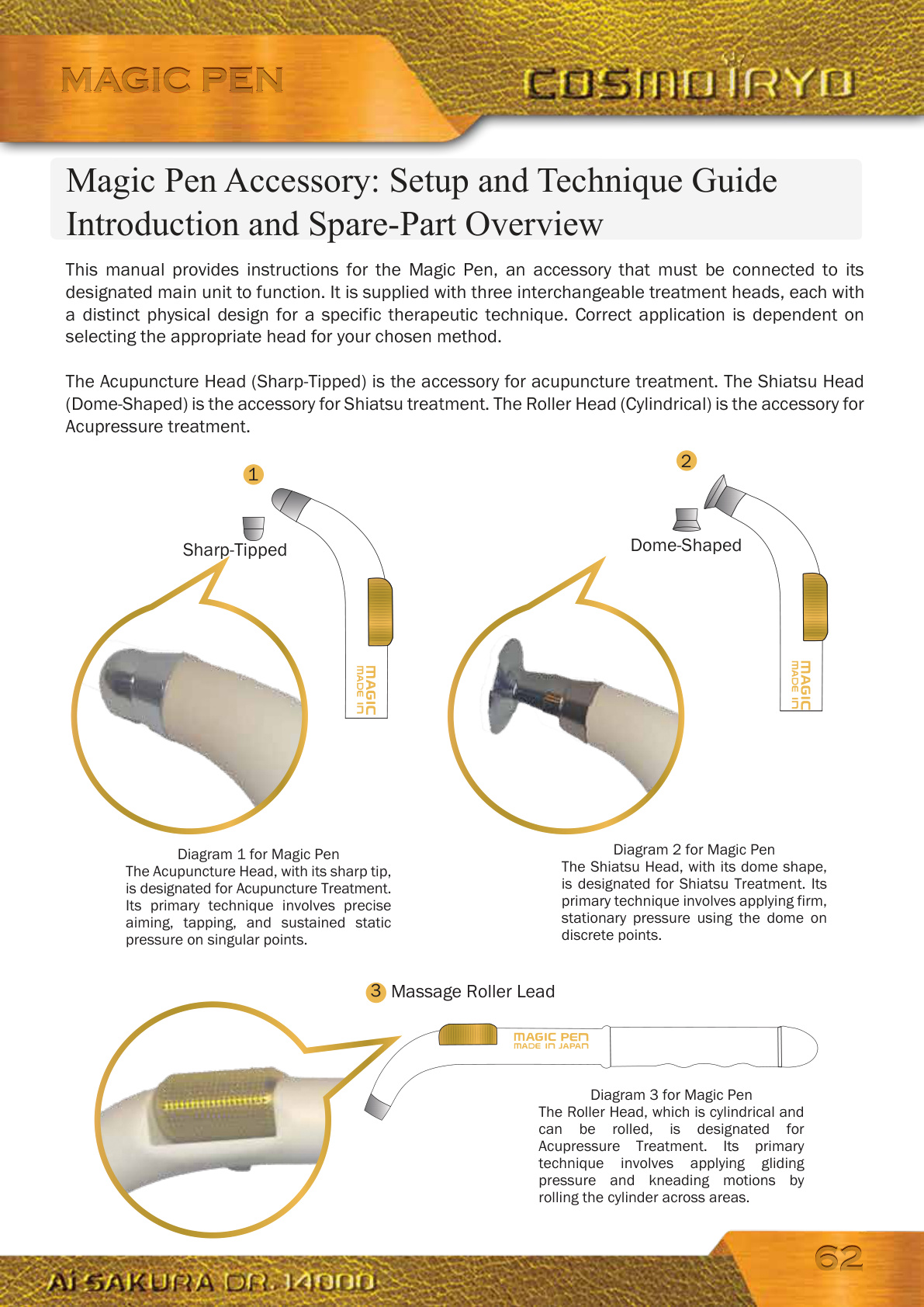
This manual provides instructions for the Magic Pen, an accessory that must be connected to its
designated main unit to function. It is supplied with three interchangeable treatment heads, each with
a distinct physical design for a specific therapeutic technique. Correct application is dependent on
selecting the appropriate head for your chosen method.
The Acupuncture Head (Sharp-Tipped) is the accessory for acupuncture treatment. The Shiatsu Head
(Dome-Shaped) is the accessory for Shiatsu treatment. The Roller Head (Cylindrical) is the accessory for
Acupressure treatment.Magic Pen Accessory: Setup and Technique Guide
Introduction and Spare-Part Overview
2
Dome-Shaped1
Sharp-Tipped
MAGIC PEN MAGIC PEN
Massage Roller Lead3
Diagram 3 for Magic Pen
The Roller Head, which is cylindrical and
can be rolled, is designated for
Acupressure Treatment. Its primary
technique involves applying gliding
pressure and kneading motions by
rolling the cylinder across areas.Diagram 2 for Magic Pen
The Shiatsu Head, with its dome shape,
is designated for Shiatsu Treatment. Its
primary technique involves applying firm,
stationary pressure using the dome on
discrete points.Diagram 1 for Magic Pen
The Acupuncture Head, with its sharp tip,
is designated for Acupuncture Treatment.
Its primary technique involves precise
aiming, tapping, and sustained static
pressure on singular points.
6262
Image placeholder filename: img-63.jpg
• Recommended ratio: portrait 3:4 (or keep original page image)
Page 64
BM

Treatment Methods and Application Techniques
This method addresses discomfort directly at the site of sensation. All three heads are suitable, with
the choice depending on the size and nature of the affected area. Apply to areas with symptoms
including numbness, pain, stabbing feelings, heat, cold, stiffness, or throbbing. It is suitable for issues
with hinges, joints, ligaments, and conditions such as gout, post-stroke effects, heart-related
problems, arthritis, skin diseases, and dizziness.
To apply this technique, first identify the precise symptomatic area. Then select the head: use the
dome-shaped Shiatsu Head for pressure on a specific spot, use the cylindrical Roller Head for a larger
area of muscle or tissue, or use the sharp-tipped Acupuncture Head for pinpoint stimulation. Apply
using rubbing, tapping, pressing, rolling, or massaging motions as appropriate for the chosen head.
Administer treatment for 10 to 20 minutes per session. Regular application is necessary to achieve
tangible improvement.Method One: Local Symptom Relief
This method involves stimulating specific anatomical points situated on the body’s pathways to
promote systemic balance. The application of pressure to these specific points is a technique used to
promote relaxation, wellness, and assist in managing disease.
For Acupoint Stimulation, use the sharp-tipped Acupuncture Head. Employ techniques of precise
aiming, pointing, tapping, and sustained pressure on points as per the provided Acupoint Chart. For
Shiatsu Treatment, use the dome-shaped Shiatsu Head to apply deep, static pressure to individual
points. Use the cylindrical Roller Head to apply therapeutic pressure along the length of a pathway or
muscle group.
To perform the procedure, locate points using the provided provided Acupoint Chart; a focus on the
hands and feet is recommended for practicality. Apply steady, comfortable pressure or motion with
the selected head. Conduct daily sessions of 10 to 20 minutes. This method is suitable for use in the
management of various conditions, including organ-related diseases, diabetes, arthritis,
hypertension, pain, spinal issues, post-stroke effects, cramping, asthma, and sinusitis.Method Two: Acupoint Stimulation and Shiatsu Treatment
MAGIC PEN MAGIC PEN
6363
Image placeholder filename: img-64.jpg
• Recommended ratio: portrait 3:4 (or keep original page image)
Page 65
BM

Methods for Using the Magic Pen
To begin, connect the male plug of the Magic Pen directly to the Receptacle Socket. Press the
MICROTRON button. Select from Pen 1, Pen 2, or Pen 3 mode. For users who are sensitive to the
static shock sensation, it is advisable to begin with P en 1 mode. Pen 2 mode delivers a stronger
sensation of static electricity, and Pen 3 mode may be more intense for users with a low pain
tolerance. However, none of the modes are dangerous. You must not select any mode other than
MICROTRON mode for this method, as doing so may result in a very strong static shock from a
14,000-volt output.The First Method
Connect the connector of the Magic Pen directly to the metal cylindrical rod and place it on the floor.
Therapy can then be administered using the Pad with any mode set to 2000, 5000, or 6000 volts
simultaneously. You must not use a therapy setting exceeding 6000 volts while using this method.
The strength of the static shock sensation from the second method is approximately half that of the
first method.
For both methods, a quick touch to the skin can be used to minimise discomfort. If you apply the head
of the Magic Pen to your body over a layer of fabric, the sensation of pain and static shock may feel
stronger because static electricity can accumulate on the material.The Second Method
MAGIC PEN MAGIC PEN
Diagram 4 for Magic Pen
Connect the Magic Pen to the Receptacle Socket
and use MICROTRON mode only. Select Pen 1,
Pen 2, or Pen 3 mode based on comfort; Pen 1 is
recommended for sensitive users. Do not select
other modes to avoid strong static shock.Diagram 5 for Magic Pen
Connect the Magic Pen to the metal rod on the
floor and use the Pad at 2,000–6,000 volts only.
Do not exceed 6,000 volts. Sensation is milder
than Method 1. Avoid use over fabric to prevent
stronger static shock.
88/gid00069PEN 1
88/gid00069PEN 1
6464
Image placeholder filename: img-65.jpg
• Recommended ratio: portrait 3:4 (or keep original page image)
Page 66
BM

ELECTRON Therapy uses high electro-potential settings of 2,000 V, 6,000 V, 11,000 V and 14,000 V,
delivered with nanoampere-range current through an electro-potential therapy device. It can operate at
up to 120 Hz, meaning the output can provide up to 120 gentle stimulation cycles per second. Many
users describe this as a subtle, rhythm-like sensation, rather than a strong or uncomfortable feeling.
The aim is to provide a consistent, controlled form of electro-potential stimulation that is easy to
tolerate during a typical session.
In ELECTRON mode, the electro-potential produces a surrounding field around the body, which may
influence how the body responds to stimulation. Under this influence, different body areas may
experience very fine vibrations, which are described as helping the body move towards a more settled
and balanced state. The therapy is also described as supporting the normal distribution of mineral ions
in body fluids, including potassium, sodium, phosphorus, magnesium and calcium, both inside and
outside cells. In particular, it is presented as supporting calcium availability and improving mineral
balance, which may assist normal muscle function, heart-muscle activity and bone support, helping you
feel less tired and more refreshed.
With increased cellular activity, body-fluid pH is described as shifting towards a slightly alkaline range
(pH 7.3 to 7.44). Red and white blood cells, together with other blood components, help regulate
hydrogen ions (H− and H+) during changes in electro-potential. This is presented as supporting the
body’s natural self-repair processes. The stimulation may also be sensed by nerves and relayed to the
hypothalamus, a key control centre for the autonomic nervous system and the endocrine system,
helping to promote overall vitality.
A 30-minute ELECTRON Therapy session is
equivalent to three hours of joggingSupports bone maintenance and recovery,
helping to reduce calcium depletion from
bones.
Supports a vitalising effect, helping you feel
less weighed down and more energised.Supports acid–base regulation (pH balance)
within the body’s normal range.
Supports blood cleansing and detoxification,
and helps maintain vascular flexibility.Supports cellular ion gradients inside and
outside the cell and promotes normal
cell-membrane permeability.
Helps maintain healthy blood pressure and
supports a balanced blood lipid profile and
viscosity.Helps manage optic-nerve tiredness and
supports healthy visual function.
Creates an ionised effect surrounding the
human body.Supports cerebral cortex regulation and helps
reduce symptoms associated with
neuro-functional strain (including headaches
and dizziness).
Supports the readjustment of mineral-ion
levels in body fluids (including potassium,
sodium, calcium, magnesium, phosphorus
and chloride) towards normal values.Supports neuroendocrine coordination,
including hypothalamic regulation of
endocrine balance and stability.
Supports calcium availability and utilisation,
helping to maintain normal functionSupports digestive regularity, including bowel
emptying patterns and normal urinary
function.
6565
The Benefit & Function of Electron Therapy
ELECTRONTHERAPYOVERVIEWELECTRONTHERAPYOVERVIEW
Mechanism of Electron Therapy
Image placeholder filename: img-66.jpg
• Recommended ratio: portrait 3:4 (or keep original page image)
Page 67
BM

COSMOTRON Therapy uses negative electro-potential settings of −5,000 V, −9,000 V and −13,000 V,
delivered with nanoampere-range current through an electro-potential therapy device. It can operate at
up to 120 Hz, meaning it may provide up to 120 gentle stimulation cycles per second. The sensation is
commonly described as subtle and steady rather than intense. The purpose of this mode is to provide
controlled negative electro-potential stimulation that supports the body’s natural recovery processes
during use.
During COSMOTRON Therapy, negative electro-potential produces a surrounding field around the body
that can influence how tissues respond to stimulation. The body may exhibit induction and polarisation
effects, and each cell is often described as behaving in a capacitor-like manner, temporarily storing and
releasing charge. This process is described as supporting the cell’s resting potential, commonly
referenced as around −90 mV, by helping to counterbalance excess positive ions such as H+. At the
same time, key ions, including potassium, sodium and chloride, are described as redistributing
according to concentration gradients, which may increase cell-membrane permeability and support
normal exchange across cell membranes. With increased negative ions, body-fluid pH is described as
shifting from acidic towards a more alkaline range. COSMOTRON output voltage is −5,000 V, −9,000 V
and −13,000 V.
COSMOTRON Therapy is also described as encouraging a rebalancing of charge distribution within body
fluids and tissues. Body constituents, including water, electrolytes and colloid molecules, may undergo
biophysical and chemical changes that can influence the physiological and pathological state of tissues
and organs. In turn, this is presented as supporting the body’s regulatory and adaptive functions, along
with nutritional support, immune function and metabolic activity, helping to promote stability and
restoration over time.
30 minutes of COSMOTRON Therapy is
equivalent to a two-hour moderate-intensity
workout.Stimulating ATP synthesis to enhance cell and
enzyme function.
Increasing anion levels to boost bioelectric
energy and restoring a healthy cell membrane
potential to maintain polarity.Reducing hepatic strain, stimulating
gastrointestinal cells and accelerating waste
removal.
Stimulating the parasympathetic system to
help manage nervous system disorders.Enhancing pulmonary ventilation and mucus
secretion, as well as increasing lung capacity.
Stimulating gamma globulin production to
enhance immunity and inherent healing.Regulating serum protein ratios (albumin
/globulin or A/G) and key mineral levels in the
blood.
Preventing vasospasm and promoting
vascular self-regulation.Improving microcirculation, relaxing
meridians, and dispersing stagnant blood.
Providing anti-inflammatory, analgesic,
calming and sleep-inducing effects; aiding
wound healing and soothing the skin.Stimulating cells to maximise capacity and
reduce free radicals.
Releasing electrons to stabilise free radicals.Boosting blood flow and alleviating symptoms
of fatigue and weakness.
6666
The Benefit & Function of Cosmotron Therapy
COSMOTRON THERAPYOVERVIEWCOSMOTRON THERAPYOVERVIEW
Mechanism of Cosmotron Therapy
Image placeholder filename: img-67.jpg
• Recommended ratio: portrait 3:4 (or keep original page image)
Page 68
BM

NEUTRON Therapy operates as a hybrid treatment by alternating between Frequency-Specific
Microcurrent (FSM) and Nanoampere-Range Current Stimulation (nA-Range Stimulation) within 40 to
120 Hz. Rather than combining them simultaneously, it cycles between the two current types, allowing
each to engage tissues through its mechanism. The frequency range remains consistent, while
amplitude and waveform shift between phases.
When the nA-Range Stimulation phase is active, the device outputs current in the nanoampere range
(billionths of an ampere). At this low amplitude, the current does not override cellular activity but
instead subtly interacts with the body's bioelectric environment. It may influence voltage-gated ion
channels and support the restoration of a normal resting membrane potential across cell membranes,
helping to establish a stable baseline.
When the sequence switches to the FSM phase, the amplitude increases to the microampere range
(millionths of an ampere). Within the same frequency window, selected frequencies are delivered to
support particular tissues and conditions. At this amplitude, the current may provide metabolic support
by enhancing ATP production, while the frequency component may create a resonant interaction with
cellular structures. This resonance is thought to influence intracellular signalling pathways and ion
exchange mechanisms across the body.
The alternating pattern is mechanistically significant. nA-Range Stimulation supports membrane
stability and cellular readiness, while FSM delivers targeted resonant input. As these phases rotate, the
body experiences a rhythmic interplay of normalisation and focused stimulation. This may reduce
cellular accommodation to a single stimulus and allow tissues such as nerves, muscles, connective
tissue and organs to respond according to their own resonant properties. The result is a unified,
system-wide engagement that supports the body's intrinsic regulatory processes without imposing a
single directional force.
A 30-minute NEUTRON Therapy session is
equivalent to 90 minutes in a saunaPromoting cellular vitality through improved
nutrient and oxygen delivery.
Helping to reduce trans fats, triglycerides and
LDL cholesterol.Assisting in reducing inflammation by removing
inflammatory mediators.
Supporting improved HDL cholesterol levels.Contributing to slowed ageing processes and
promoting longevity.
Inducing a deep-tissue thermal effect, raising
core temperature by 1–2 °C.Strengthening the immune response via
systemic stimulation.
Promoting vasodilation to boost systemic
blood flow and circulation.Facilitating muscular relaxation to ease
tension and stiffness.
Elevating metabolic rate, stimulating cellular
activity, and accelerating fat breakdown.Providing a non-invasive wellness intervention.
Aiding weight management by supporting
fat-burning processes.Helping to regulate the body's bio-balance and
remove the state of magnetisation.
6767
The Benefit & Function of Neutron Therapy
NEUTRON THERAPYOVERVIEWNEUTRON THERAPYOVERVIEW
Mechanism of Neutron Therapy
Image placeholder filename: img-68.jpg
• Recommended ratio: portrait 3:4 (or keep original page image)
Page 69
BM
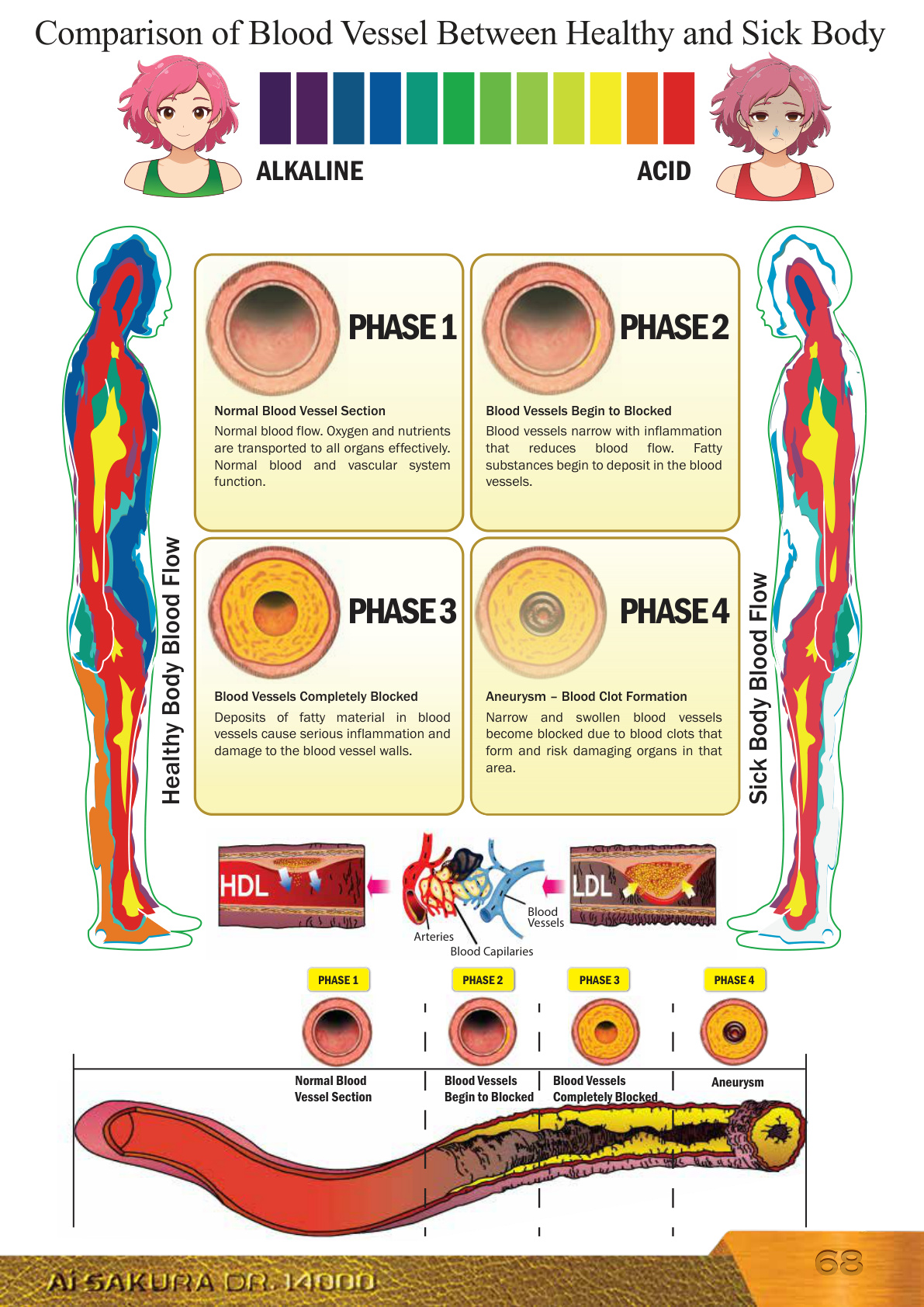
Arteries
Blood CapilariesBlood
Vessels
Comparison of Blood Vessel Between Healthy and Sick Body
Normal Blood
Vessel SectionBlood Vessels
Begin to BlockedBlood Vessels
Completely BlockedAneurysmHealthy Body Blood Flow
Sick Body Blood FlowALKALINE ACID
PHASE 1
 PHASE 2
 PHASE 3
 PHASE 4
Normal blood flow. Oxygen and nutrients
are transported to all organs effectively.
Normal blood and vascular system
function.Normal Blood Vessel Section
Blood vessels narrow with inflammation
that reduces blood flow. Fatty
substances begin to deposit in the blood
vessels.Blood Vessels Begin to Blocked
Deposits of fatty material in blood
vessels cause serious inflammation and
damage to the blood vessel walls.Blood Vessels Completely Blocked
Narrow and swollen blood vessels
become blocked due to blood clots that
form and risk damaging organs in that
area.Aneurysm – Blood Clot FormationPHASE 1
PHASE 3PHASE 2
PHASE 4
6868
Image placeholder filename: img-69.jpg
• Recommended ratio: portrait 3:4 (or keep original page image)
Page 70
BM

Cholesterol
Blocked
Blood
VesselsFoodLack of Exercise
Stress
Acidic Blood Vessels
Alkaline Blood Vessels
OxygenAntibodiesHormonNutrients
Environment
ELECTRON POTENTIAL THERAPYBefore Therapy
After TherapyBlocked blood vessels cause the blood to become dirty and thick,
which interferes with the delivery of oxygen, nutrients, antibodies,
and hormones to all body cells and causes the body to become
sick.
Clean, alkaline blood increases the effectiveness of delivering
oxygen, nutrients, antibodies, and hormones to all body cells and
improves overall health.
Healthy and unblocked
blood vessel section.Blocked and sick
blood vessel section.
Ion-ion operation in
the order.
Normal blood vessel
section.Ion-ion operation in
the order.
Narrow blood vessel
section.
6969
Image placeholder filename: img-70.jpg
• Recommended ratio: portrait 3:4 (or keep original page image)
Page 71
BM
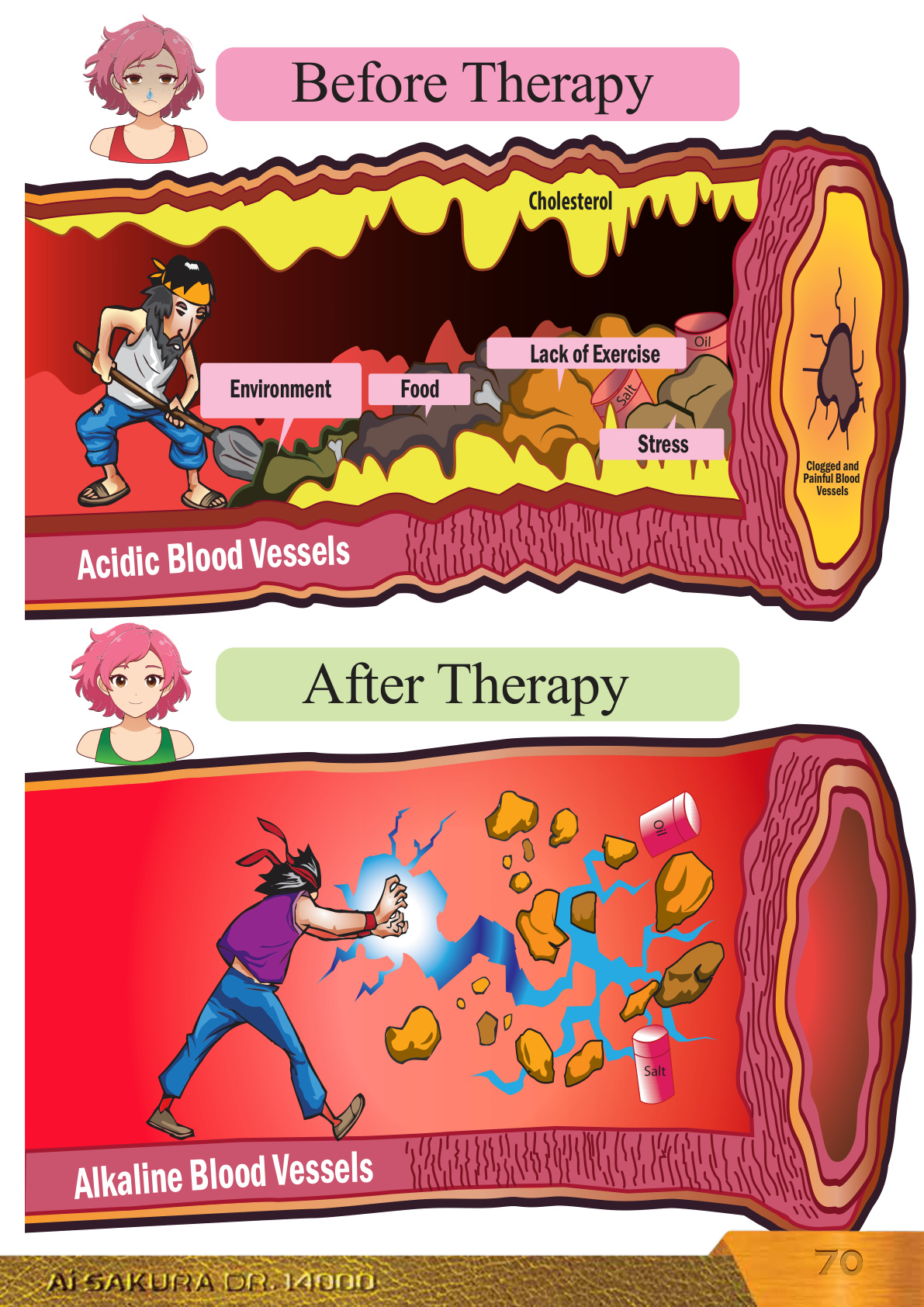
Cholesterol
Clogged and
Painful Blood
VesselsEnvironment FoodLack of Exercise
Stress
Acidic Blood Vessels
Alkaline Blood Vessels
After TherapyBefore Therapy
7070
Image placeholder filename: img-71.jpg
• Recommended ratio: portrait 3:4 (or keep original page image)
Page 72
BM
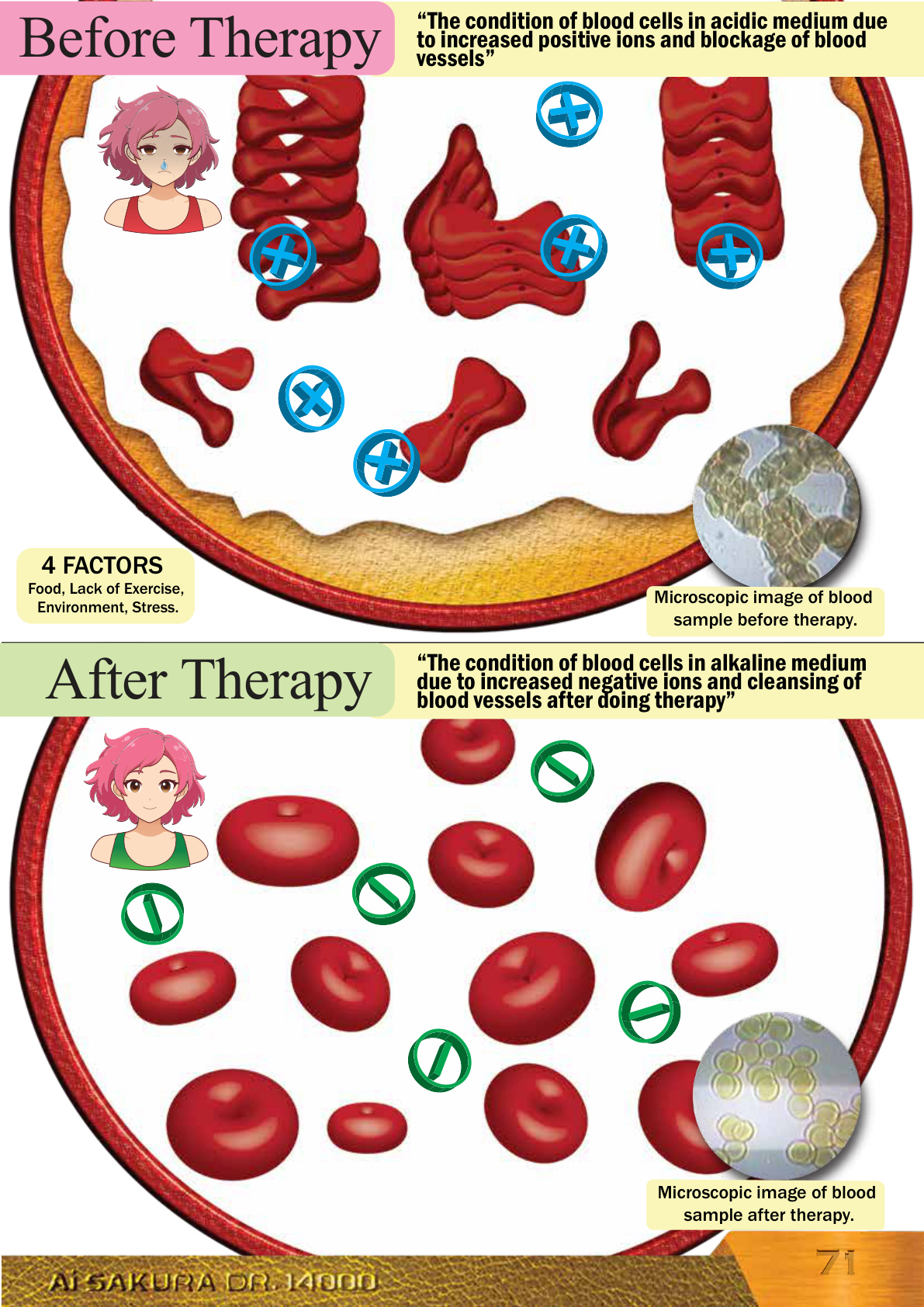
Microscopic image of blood
sample before therapy.
Microscopic image of blood
sample after therapy.
4 FACTORS
Food, Lack of Exercise,
Environment, Stress.
7171
Before Therapy“The condition of blood cells in acidic medium due to increased positive ions and blockage of blood vessels”
After Therapy“The condition of blood cells in alkaline medium due to increased negative ions and cleansing of blood vessels after doing therapy”
Image placeholder filename: img-72.jpg
• Recommended ratio: portrait 3:4 (or keep original page image)
Page 73
BM

HEMEOSTATIS
“Humans are Born with Natural Healing Power”
Homeostasis is the natural healing power or
the ability of the human body to maintain
the internal balance of the body in any
situation.
Homeostatic mechanisms operate at
all hierarchical levels in the human
life system. The factors of
nutrition, stress, lack of exercise
and environment affect the
body homeostatic balance.
Certain diseases occur
because of the failure of
certain systems in the
human body.
Examples are as follows:
a) When you have a fever, your body temperature will increase to kill bacteria or viruses in your bloodstream. After the bacteria or viruses
are gone, your body temperature returns to normal levels.
b) After doing heavy work, your body temperature rises and you sweat a lot to lower your body temperature to normal.
c) When you enter a dark room from bright light, you cannot see anything for a few seconds. Within a few seconds, you can adjust your
vision to dim light and move easily.
d) Your body needs to maintain a blood sugar reading level for your cells to always function optimally. When you eat something sweet, the
sugar level in your body is high, causing your body to produce and release insulin into your bloodstream. Diabetes is a failure of glucose
homeostasis. Diabetic patients need help their bodies maintain blood glucose homeostasis through insulin injection.Can You Expect To Stay Healthy Without Practising Health Care Methods And Routines?
First Stage
Initial
Body
Reaction
Final
Body
Reaction
Human Natural Healing Power Second Stage Third Stage
Blood vessels that
are clogged and
acidic , causing
disease.Food
Stress
Lack of Exercise
EnvironmentImmuneSystem
Resistance System
Body From Bacteria
EndocrineSystem
Hormonal Secretion
SystemAutonomic NervousSystem
(Sympathetic Nerves
And Parasympathetic
Nerves)HOMEOSTASIS
RESTORATION
Blood circulation disorder
throughout the body that
disrupts the delivery of
nutrients, oxygen and
important substances
that body cells need.
The nervous system
becomes uncontrolled
and disturbed.The causes of
chronic diseases
occur gradually
and continuously
in daily life, which
become chronic
diseases later.The healing
power of the
human body
fails to
function.
Becoming a
patient to
certain
diseases.
7272
Health levels can be maintained
when homeostatic balance can be
maintained and disease occurs
when this balance is disturbed.
Image placeholder filename: img-73.jpg
• Recommended ratio: portrait 3:4 (or keep original page image)
Page 74
BM

Ionosphere300 000 V
Natural Electro-potential Fields
Electro-potential Fields Surrounding
the World
Natural Environment
 Transformed into an Urban Area
Changes in Natural Electro-potential Field by
Buildings, Power Substations, Development
and others.Electro-potential Fields
Ionosphere
Ozone Layer100 Million Volts of Electro-potential Produced by Lightning
100~200Km
Air
Earth’s Natural
Electro-potential FieldA Potential Energy
Difference of Electro-potential
Fields of 300, 000 Volts
Produced by the Ionosphere and
Earth’s Surface
Stratosphere
Tropospfera
Benefits of Natural Electro-potential Fields
from the Earth’s Atmospheric LayerBenefits of Natural Electro-potential Fields
from the Earth’s Atmospheric Layer
CATION ANION
7373
Image placeholder filename: img-74.jpg
• Recommended ratio: portrait 3:4 (or keep original page image)
Page 75
BM
Benefits of the Earth’s Natural Electro-Potential Field
7474
NATURAL
ENERGYNATURAL
ENERGY
Natural atmospheric fields exist on a vast scale. There is a saying that “Many lightning strikes lead to a
year full of luck”, and at times the measured atmospheric potential difference can exceed 100 million
volts. As illustrated, the Earth is surrounded by a natural field commonly described as the Atmospheric
Potential Gradient (PG). The ionosphere is a region of ionised gases about 100 km above the Earth and
is associated with a strong natural potential field.
Historically, people were exposed to this background field more consistently. However, modern
development such as tall buildings, power substations, deforestation and new construction can alter
local field distribution. As a result, everyday exposure to the natural field may be reduced or less
stable in some environments. For this reason, Potential Therapy is often described as a practical
approach that provides a controlled field environment, sometimes referred to as a Static Field or
Natural Charge Field, to help replicate aspects of natural exposure.What is the Atmospheric Potential Gradient (PG)?
Potential Therapy is based on the idea that living organisms generate very small bio-currents as part
of normal physiology. These signals can be observed through standard tests such as
electrocardiography (ECG), electroencephalography (EEG) and electromyography (EMG).
Bio-currents arise largely from ion movement across cell membranes. For example, when Na+ and
K+ ions move in nerve and muscle cells, an ionic current is produced. This process occurs
continuously throughout the body and reflects ongoing cellular function.
Cell membranes regulate what is retained inside the cell and what is released outside for removal
or use elsewhere. As nutrients, waste products and oxygen are processed and transported,
ionisation and membrane transfer may be associated with low-level rhythmic activity, commonly
described within a frequency range of 1–100 Hz.
In healthy tissue, these patterns are described as stable. When tissue is affected or damaged, the
body seeks balance through homeostasis: damaged components are cleared and repair processes
are supported. This requires materials to move into and out of cells, making membrane transport
and ion movement closely linked to recovery.
The aim of therapy is to deliver a controlled external field and gentle stimulation patterns that align
with naturally occurring bio-signals in the area requiring support.
This approach is described as supporting tissue recovery and promoting nervous system balance,
which may help with comfort and support the regulation of sympathetic nerve activity.
The natural atmospheric field is described as supporting cellular activity and metabolism.
When applied as a controlled field, it is described as acting throughout the body to support balance
and peripheral nerve function.
This may support the body’s natural recovery rate and overall function.Electro-Potential Therapy Concept
Natural Healing Support
Image placeholder filename: img-75.jpg
• Recommended ratio: portrait 3:4 (or keep original page image)
Page 76
BM
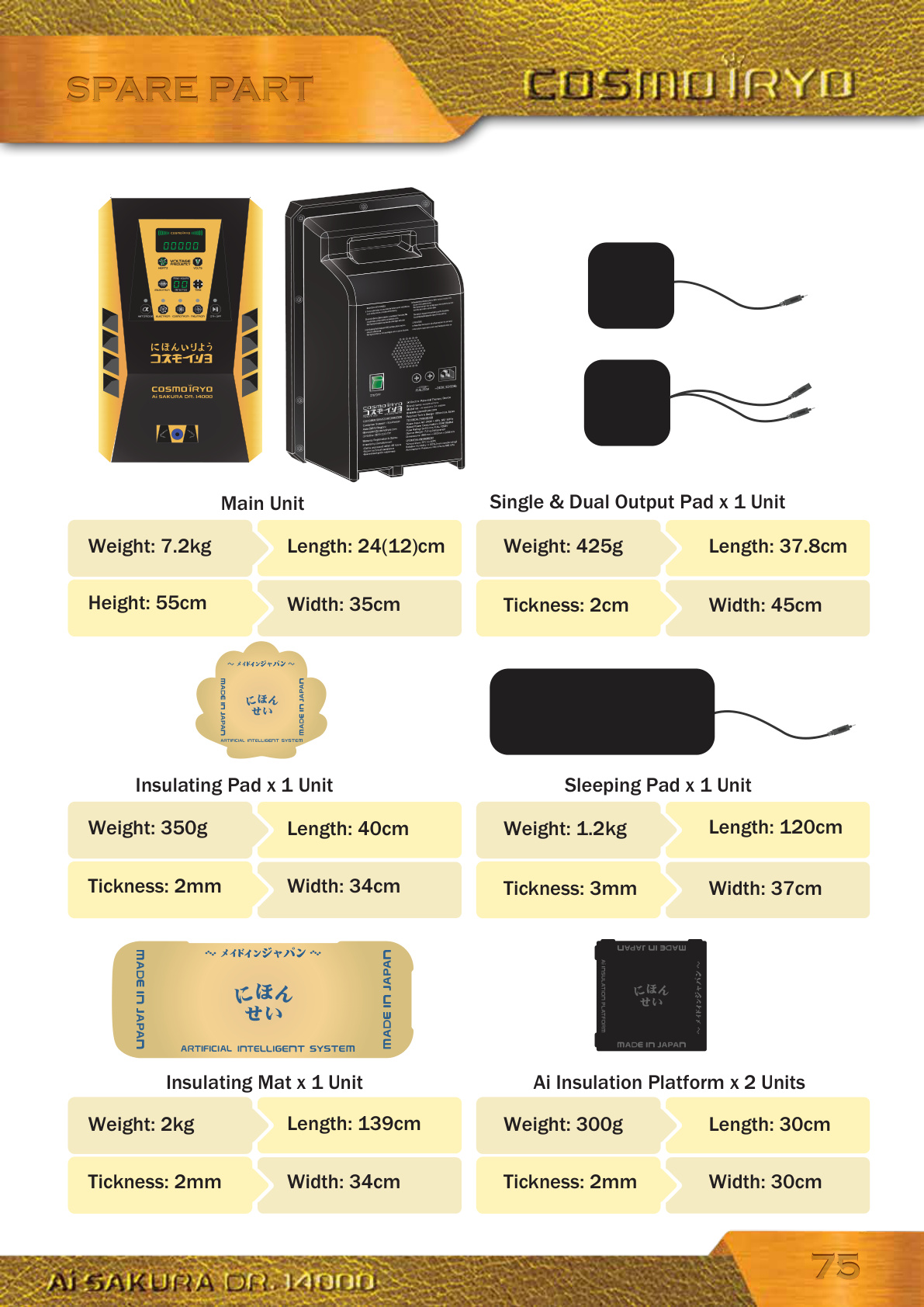
7575
Weight: 7.2kg
Height: 55cmMain Unit
Width: 35cmLength: 24(12)cm
Insulating Pad x 1 Unit Sleeping Pad x 1 Unit
Weight: 350g Length: 40cm
Width: 34cm Tickness: 2mmWeight: 1.2kg Length: 120cm
Width: 37cm Tickness: 3mmWeight: 425g
Tickness: 2cm
Insulating Mat x 1 Unit Ai Insulation Platform x 2 Units
Weight: 300g Length: 30cm
Tickness: 2mm Width: 30cmWeight: 2kg Length: 139cm
Tickness: 2mm Width: 34cmSingle & Dual Output Pad x 1 Unit
Length: 37.8cm
Width: 45cm
SPARE PARTSPARE PART
/gid00069
Image placeholder filename: img-76.jpg
• Recommended ratio: portrait 3:4 (or keep original page image)
Page 77
BM
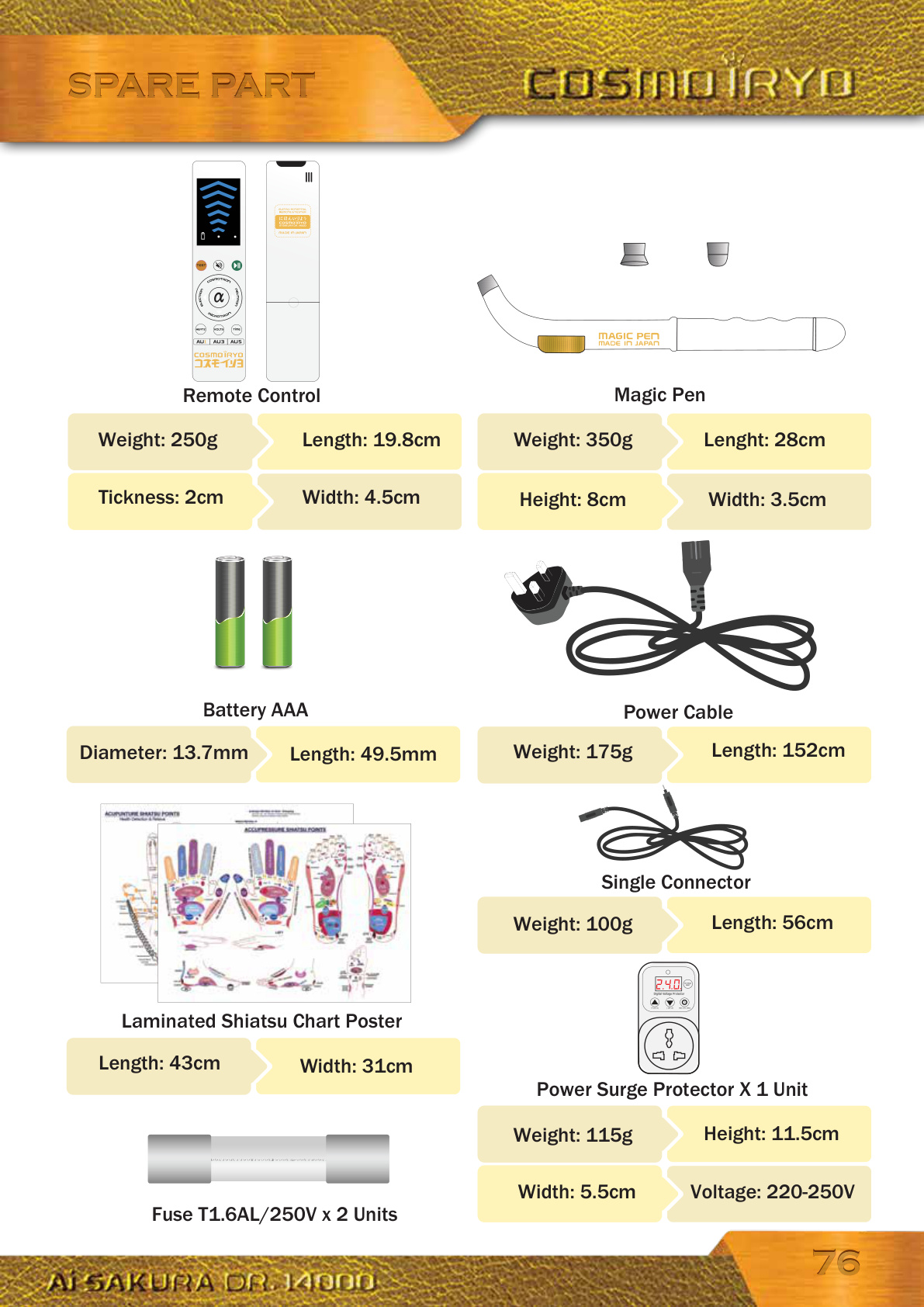
7676
Weight: 250g Length: 19.8cmRemote Control
Diameter: 13.7mm Length: 49.5mmBattery AAAWidth: 4.5cm Tickness: 2cmWeight: 350g Lenght: 28cm
Height: 8cm Width: 3.5cmMagic Pen
Length: 43cm Width: 31cmWeight: 175g Length: 152cm
Power Cable
Weight: 100g Length: 56cmSingle Connector
Laminated Shiatsu Chart Poster
Weight: 115g Height: 11.5cmPower Surge Protector X 1 Unit
Fuse T1.6AL/250V x 2 UnitsVoltage: 220-250V Width: 5.5cm
SPARE PARTSPARE PART
Image placeholder filename: img-77.jpg
• Recommended ratio: portrait 3:4 (or keep original page image)
Page 78
BM

Voltage ForceHypothalamic
Pituitary
Electro-potential
Conductor Pad
Ai Insulation
PlatformStatic Current
Flow
Electron potential therapeutic device generates electrostatic fields force to simulate the senses of touch on the skin and ultimately
restores control of body functions in the autonomic nervous system such as the hypothalamic-pituitary.
WHO recognizes 2 effects on the human body's response when exposed to electron potential therapeutic devices:
1) Stimulation of the organ's sensory receptor surface by electrostatic field currents.
2) Increased level of activity of body cells by generation of electrstatic field currents.
Natural Power Generated from Electro-potential
Stimulation:
NATURAL POWERNATURAL POWER
7777
Image placeholder filename: img-78.jpg
• Recommended ratio: portrait 3:4 (or keep original page image)